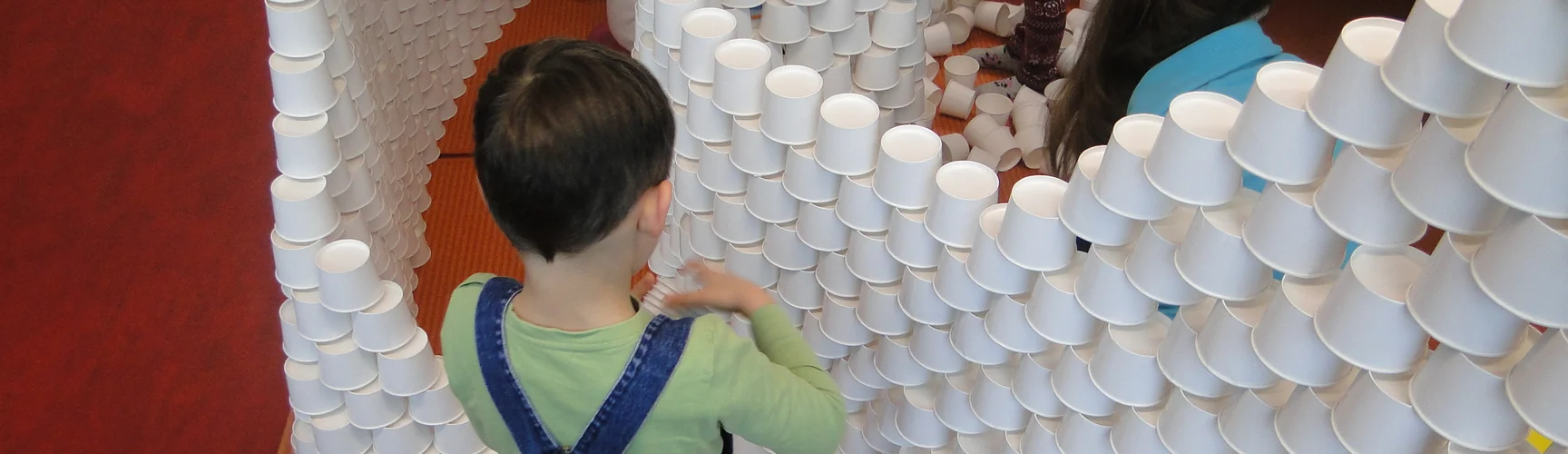
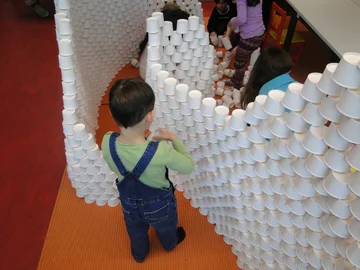
Ein Kind baut hohe Mauern aus Eisbechern.

MiniMa Teaching and Learning Lab

Minis and adults discover mathematics

Mathematical skills acquired before starting school form the foundation for successful learning at school, academic achievement and participation in society. Early mathematical learning processes require expert guidance from qualified teaching staff.

The project therefore focuses on:

  • the professional development of early years practitioners, teachers in the early years of schooling, and students specialising in early mathematical education (early childhood education and primary school teacher training),
  • the development and academic support of a teaching and learning laboratory for early mathematical education,
  • the development of mathematical play and learning environments in early education,
  • research into numerous aspects of early mathematical education, such as mathematical thinking and learning processes, mathematical interactions in teaching and learning contexts, and opportunities for professional development in mathematics education.

The research and development project ‘Minis and Adults Discover Mathematics’ (MiniMa) was initiated and developed in 2010 by Prof. Dr Christiane Benz and Dr Johanna Zöllner.

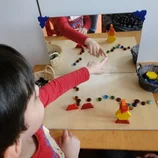
Ein Kind zeigt auf einen Spiegel auf einem Tisch, vor dem Spiegel liegen Bauklötze und Steinchen.

Mathematics is not a body of knowledge. Mathematics is an activity, a way of behaving, a state of mind. […] However, one does not learn a mindset by having someone briefly tell you how to behave. One learns it through active engagement, by solving problems – either alone or in a group – problems that involve mathematics.

Freudenthal 1982, S. 140

The professional development of educational specialists and teachers


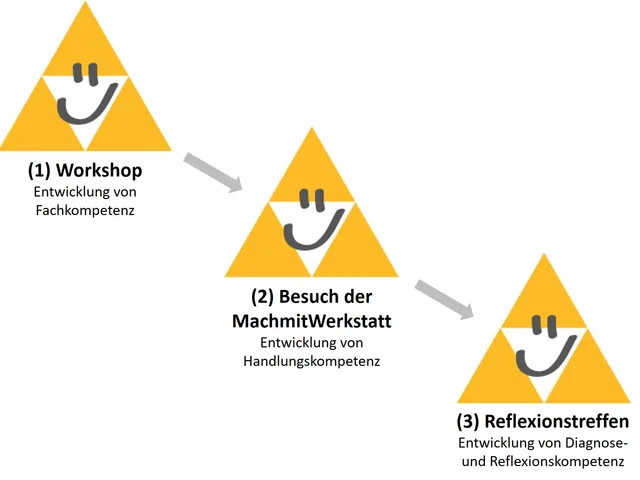
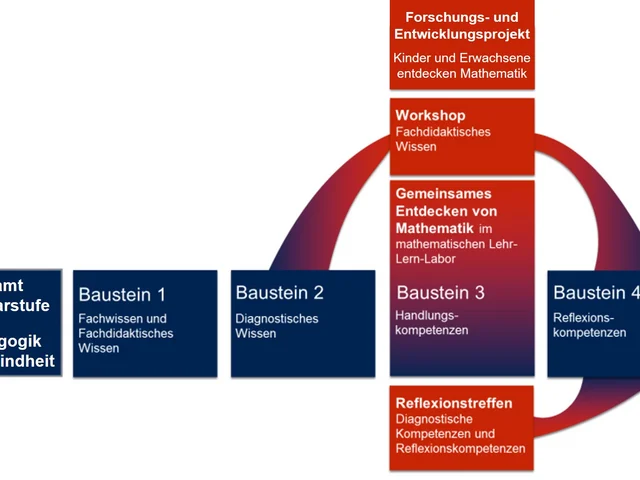
Once or twice a year, a professional development phase begins for educational specialists and teachers, focusing on a specific area of mathematical content such as ‘Counting and Observing’ or ‘Comparing and Measuring’. Each professional development phase is divided into three modules: a workshop, a visit to the MachmitWerkstatt with groups of children, and a reflection session. Each module, in turn, focuses specifically on a particular aspect of competence (subject-specific, practical, diagnostic and reflective competence) that the learning facilitators can acquire and further develop (Figure 1). 

Figure 1: The three training modules

(1) Workshop

Each phase of the training programme begins with a workshop in which the teaching assistants have the opportunity to acquire or consolidate their subject-specific and pedagogical knowledge in the field of mathematics. Theory and practice are interwoven. The focus is on the fundamentals of mathematics education (subject expertise) as well as on fostering motivation and enthusiasm for discovering mathematics.

Educational specialists, school teachers and university lecturers work together to consider which play and learning environments can be designed for the respective subject area. This planning and design of the play and learning environments, including suggestions for expected interactions (actions, prompts, questions), is discussed with the participants.

The planning and design are documented and subsequently made available in written form to all participants, so that they can implement the play and learning environments in their respective institutions.

The following content-related aspects have so far been jointly developed and tested in play and learning environments (see Benz 2010):

  • Counting and Seeing
  • Exploring patterns
  • Comparing and measuring
  • Building and laying
  • Organising, sorting and communicating
  • Identifying Structures
  • Symmetry
  • Mathematical discoveries through reflection
  • Interactive reading and reading-along with maths-themed picture books

(2) Visit to the MachmitWerkstatt MiniMa

After taking part in the workshop, educational specialists and teachers will have the opportunity to visit the MiniMa workshop – the centrepiece of the research and development project – together with their group of children. Here, the play and learning environments they have developed can be put into practice, and the learning facilitators are supported in acquiring their pedagogical and didactic practical skills.

They can observe and encourage the children’s mathematical discoveries and reflect on them together with the children. They are supported by two student assistants who encourage mathematical discoveries and discussions about mathematical content, and who document the children’s learning processes as they discover mathematical relationships on video. The focus here is on supporting children’s learning as they discover mathematics (practical competence).

The following guiding principles on the discovery of mathematics are fundamental to the work with the children at the MachmitWerkstatt MiniMa:

Children discover
mathematics……through play,
……indirectly,
……individually and in different ways,
……together with other children and with the learning facilitators (cf. Benz 2010).

The introductory quote from the Dutch mathematics educator Hans Freudenthal describes mathematics as an active pursuit characterised by individual and collaborative problem-solving. At MiniMa, children and learning facilitators are given the opportunity to engage with challenging maths-related situations in a playful, exploratory way and to immerse themselves in exploring mathematical ideas and connections.

The following images provide a brief insight into the MachmitWerkstatt MiniMa.

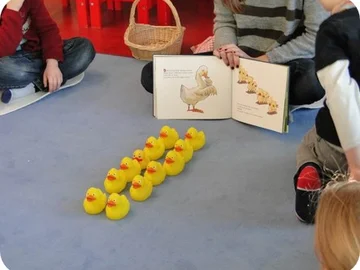
  • Eine Person hält ein Bilderbuch mit Entenbilden, davor stehen 12 gelbe Gummienten auf dem Boden.
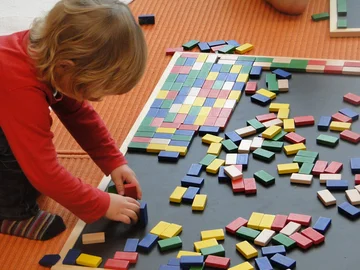
  • Ein Kind spielt auf dem Boden mit bunten Dominosteinen.
  • Ein Kind baut hohe Mauern aus Eisbechern.
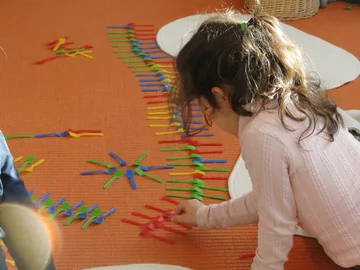
  • Ein Kind legt Muster auf dem Boden aus bunten Eislöffeln.
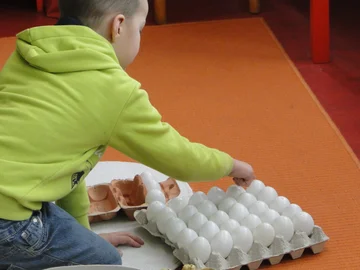
  • Ein Kind zählt Eier in einer Eierpalette ab.

(3) Reflection sessions

At the end of the training phase, a joint reflection session with the learning facilitators is offered. Given the time that has elapsed, this is intended to facilitate an in-depth analysis by discussing, with the aid of video clips, the processes of mathematical discovery experienced by the learning facilitators with their groups of children.

During the joint reflection sessions, participants reflect on communication patterns between children and adults and on their own professional practice (reflective competence), whilst also analysing and discussing children’s problem-solving processes against the backdrop of theoretical models (diagnostic competence). Finally, alternative approaches are developed collaboratively. Furthermore, the design of the learning and exploration environment is evaluated, and ways in which it can be implemented in the learning facilitators’ day-to-day work are discussed.

Information on how to register for the three-part training programme can be found here.

MiniMa Teaching and Learning Laboratory


By linking the three-phase research and development project (workshop, collaborative exploration in the MachmitWerkstatt, reflection) (see Fig. 1 and Fig. 2, red column) is linked to teaching (see Fig. 2, blue bar), the MiniMa teaching and learning laboratory is created.

Figure 2: Linking the various phases of the research and development project ‘Minis and Adults Discover Mathematics’ (MiniMa) in Benz, C. (2014) with the degree programmes ‘Primary School Teacher Training’ and ‘Early Childhood Education’

The MiniMa teaching and learning laboratory offers students an excellent integration of theory and practice and was awarded a fellowship for innovative university teaching by the Baden-Württemberg Foundation and the German Association of Donors as early as 2013:

The prevailing situations for action and observation under laboratory conditions, outside the constraints of educational institutions, create a safe, simplified environment with excellent conditions for observation and reflection. Educators and teachers can thus discover and explore mathematics together with their children in the play and learning environments prepared by students (cf. professional development of educational specialists and teachers). The scope for action provided by the ‘MachmitWerkstatt MiniMa’ offers student teachers on placement the opportunity to engage in research-based activities with the children, based on the principle of discovery-based and action-oriented learning. A key aspect of professional development here is the in-depth reflection on practical situations based on video recordings.

Video recording of the learning environments enables an in-depth analysis of both learning and teaching processes and provides an excellent basis for various phases of reflection (see, for example, Kleinknecht & Schneider, 2013). The video material is used for both individual and collaborative reflection within a small group. The reflective work in a group setting is guided by the criteria for successful video-based learning groups as outlined by van Es (2012): collegial and collaborative interactions, participation and norms of discourse, and a focus on the teaching and learning processes. Students support one another in their reflection and broaden their perspectives by drawing on those of other group members. Early mathematical discovery processes can thus be stimulated, guided and supported with increasing competence and professionalism.

In addition to competences in mathematics education within the field of early childhood education, the development of cross-curricular competences is also promoted. The subject-independent effectiveness of cooperative reflective work using video sequences in small groups has been empirically demonstrated in relation to the construction and activation of knowledge, the ability to adopt different perspectives, a professional perception of and reflection on interactions, and changes in one’s own behaviour within the teaching-learning context (Altmann and Kändler, 2019). The scientific evaluation of the reflection concept in the MiniMa teaching and learning laboratory also confirms an influence on the development of students’ general pedagogical attitudes (Reuter, forthcoming).

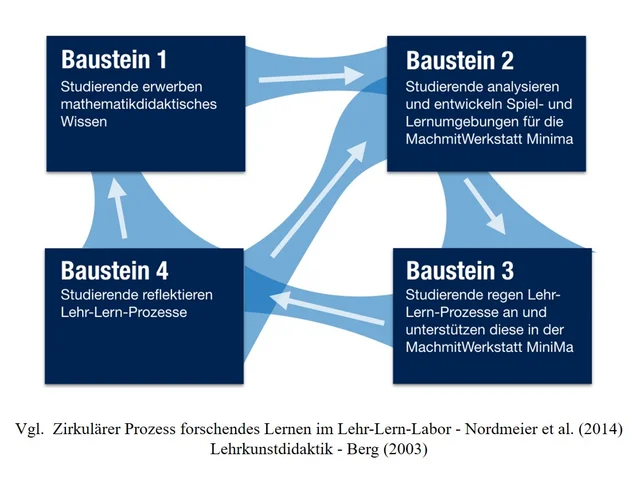
The R^5 project, which was awarded a Fellowship for Innovation in Higher Education Teaching by the Stifterverband and the Baden-Württemberg Foundation, draws on these circular interconnections between theoretical, practical and reflective competences. A significant innovation of this concept is that all components within a subject area are linked to one another in a circular manner, and the various competences are acquired through examples drawn from a specific content area (see Fig. 3). The circular interlinking of the various building blocks creates a distinctive form of theory-practice integration.


Figure 3: Linking the modules

Key areas of research and publications


The MiniMa project offers numerous points of connection for various research projects. These are attracting the interest of numerous researchers far beyond national borders. Among other things, there is international collaboration with, for example, Israel, Australia, Sweden and Norway.

Selected publications on specific subject areas are listed below.

Professional development processes for trainee specialists and teachers,

Publications (selection)

  • Reuter, F. & Benz, C. (2023). Pre-service kindergarten teachers’ development of competences in an out-of-school environment. In Esther Levenson and Ruthi Barkai (Eds.). Playful mathematics learning during the early years: Out-of-school environments.
  • Benz, C., Reuter, F., Maier, A., & Zöllner, J. (2023). Kindergarten professionals’ perspectives on observing children’s mathematical competences. In H. Palmér, C. Björklund, E. Reikerås, & J. Elofsson (Eds.), Teaching Mathematics as to be Meaningful – Foregrounding Play and Children’s Perspectives (pp. 171–183). Springer International Publishing. https://doi.org/10.1007/978-3-031-37663-4_13
  • Gasteiger, H., Bruns, J., Benz, C., Brunner, E. & Sprenger, P. (2020). Mathematical pedagogical content knowledge of early childhood teachers: a standardised situation-related measurement approach. ZDM Mathematics Education, 52, 193–205. doi.org/10.1007/s11858-019-01103-2
  • Benz, C. (2016). Reflection – An opportunity to address different aspects of professional competencies in mathematics education. In T. Meaney, T. Lange, A. Wernberg, O. Helenius & M.A. Johansson, (Eds.), Mathematics Education in the Early Years – Results from the POEM2 Conference, 2014 (pp. 419–435). New York: Springer.
  • Benz, C. & Zöllner, J. (2018). On the importance of reflection for professional development processes. Dialog 5 (1), 22–27.
  • Reuter, F. (2019). Reflection on mathematics teaching in early years education studies
  • Gasteiger, H. & Benz, C. (2018). Enhancing and analysing kindergarten teachers’ professional knowledge in early mathematics education. The Journal of Mathematical Behaviour, 51(9), 109–117. https://doi.org/10.1016/j.jmathb.2018.01.002
  • Gasteiger, H., & Benz, C. (2016). Mathematical teaching competence of early years professionals – a theory-based competence model. Journal of Mathematics Education, 37(2), 263–287.
  • Benz, C. (2012). “Maths is not dangerous” – Attitudes of people working in German kindergartens towards mathematics in kindergarten. European Early Childhood Education Journal, 20(2), 249–261.
  • Benz, C. (2012). Attitudes of nursery school teachers towards maths. Journal of Mathematics Education, 33(2), 203–232.

Publications (selection)

  • Reuter, F. & Benz, C. (2023). The use of gesture in early mathematics learning situations. In Esther Levenson and Ruthi Barkai (Eds.). Playful mathematics learning during the early years: Out-of-school environments
  • Reuter, F. (2023): Explorative mathematical argumentation: a theoretical framework for identifying and analysing argumentation processes in early mathematics learning. Educational Studies in Mathematics 112, 415–435. doi.org/10.1007/s10649-022-10199-5
  • Reuter, F., Grummel, S., Gatzke, V. (2023): Is one green, is two red? Supporting children with synesthetic perception in early-stage mathematics education. Grundschulmagazin 04/2023, 25–29
  • Benz, C. & Tiedemann, K. (2021). Talking to children about structures. In A.-K. Harr & B. Geist (Eds.), Language support in nursery schools. DTP Volume 12, (pp. 409–425.) Hohengehren.
  • Benz, C. (2020). Discovering mathematics with children. In G. Müller & R. Thümmler (Eds.). Early childhood education: between aspiration and reality. New perspectives on childhood and family education (pp. 223–235). Weinheim, Basel; Beltz
  • Benz, C. & Tiedemann, K. (2020). Structuring Interpretations as a Linguistic Challenge. In Hans-Stefan Siller. In Wolfgang Weigel & Jan Franz Wörler (Eds.), Contributions to Mathematics Teaching 2020 (pp. 1241–1244). Münster: WTM-Verlag
  • Gasteiger, H., & Benz, C. (2020). Learning mathematics during the transition – focusing on the child and the subject. In: Pohlmann-Rother, S., Franz, U. & Lange, S. D. (Eds.). Cooperation between Nursery and Primary School. Volume 1: Insights into Research – Perspectives for Practice. 2nd revised and expanded edition (pp. 206–229). Carl Link-Verlag, Cologne.
  • Maier, A. S.; Benz, C. (2020). ‘A triangle is like a tent’. Children’s Conception of Geometric Shapes. In: Mathematics Education in the Early Years. Results from the POEM4 Conference 2018. Springer.
  • Sprenger, P. & Benz, C. (2020). Children’s perception of structures when determining cardinality of sets—results of an eye-tracking study with 5-year-old children. ZDM, 51 (1), 187. https://doi.org/10.1007/s11858-020-01137-x
  • Sprenger, P. & Benz, C. (2020). Perceiving and using structures when determining the cardinality of sets – A child’s learning story. In M. Carlsen, I. Erfjord & P. S. Hundeland (Eds.), Mathematics education in the early years. Results from the POEM4 Conference, 2018 (213–227). Springer
  • Maier, A. S. (2019). Geometric conceptual understanding in 4- to 6-year-old children. In England and Germany (Empirical studies on the didactics of mathematics). Münster: Waxmann.
  • Sprenger, P. & Benz, C. (2019). Perceiving and using structures in sets – the contribution of eye-tracking in a three-level evaluation process. In U. T. Jankvist, M. van den Heuvel-Panhuizen & M. Veldhuis (Eds.), Proceedings of the Eleventh Congress of the European Society for Research in Mathematics Education (CERME11, 6–10 February 2019) (pp. 2355–2362). Utrecht, the Netherlands: Freudenthal Group & Freudenthal Institute, Utrecht University and ERME.
  • Schöner, P. & Benz, C. (2018). Visual structuring processes of children when determining the cardinality of sets – the contribution of eye-tracking. In C. Benz, H. Gasteiger, A. S. Steinweg, P. Schöner, H. Vollmuth, & J. Zöllner (Eds.), Early Mathematics Learning – Selected Papers of the POEM Conference 2016. New York: Springer.
  • Maier, A.S.; Benz, C. (2014). Children’s conceptual knowledge of triangles as manifested in their drawings. In P. Liljedahl,  S. Oesterle, C. Nicol, & D. Allan (Eds.), Proceedings of the Joint Meeting of PME 38 and PME-NA 36 (Vol. 4) (pp. 153–160). Vancouver, Canada: PME.
  • Maier, A.S.; Benz, C. (2013). Selecting Shapes: How Children Identify Familiar Shapes in Two Different Educational Settings. In V. Ubuz (Ed.), Proceedings of the 8th Congress of the European Society for Research in Mathematics Education (pp. 2186–2177). Antalya, Turkey: ERME

Learning environments for early mathematical education

Publications (selection)

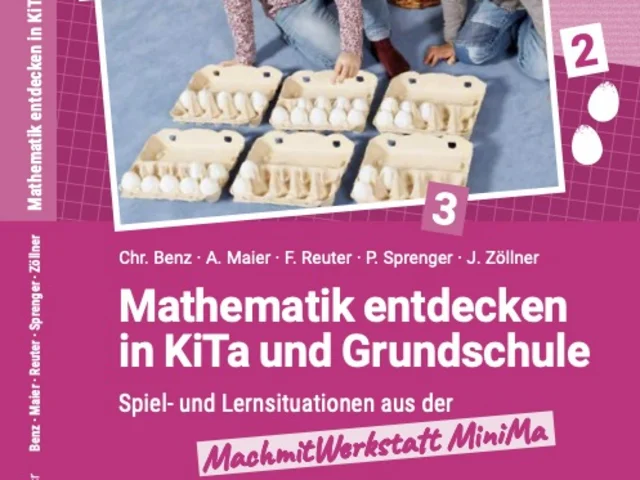
  • Benz, C., Maier, A., Reuter, F., Sprenger, P. & Zöllner, J. (2024) Discovering Maths in Nursery and Primary School. Play and learning situations from the MachmitWerkstatt MiniMa. Klett Kallmeyer.
  • Benz, C. & Schulz, A. (2024). “Why don’t you make hundreds, then you’ll see it better” – Structuring number representations and understanding additive number structures. Grundschulzeitschrift 345/2024, 12–15.
  • Benz, C. & Schulz, A. (2024). “Do it a bit neater, then you’ll see it better” – From quick recognition to grasping large numbers. Primary School Magazine 04/2024, 11–15.
  • Maier, A. S. & Reuter, F. (2024): “A shape can’t have two names!” Conceptual scope and class inclusion in the area of quadrilaterals. Primary School Mathematics 81/2024, 8–11.
  • Reuter, F. (2022): Sorting shapes. Communicating and reasoning in geometry lessons. Fördermagazin Grundschule 2022(4), 16–18.
  • Reuter, F. (2022): Who’s sneaked in – and why? Communicating and reasoning through play. Primary School Magazine 02/2022, 28–32.
  • Benz, C., Reuter, F. & Zöllner, J. (2021): Discovering mathematics. On the role of processes and structures in early mathematical education. Early Childhood 4/21.
  • Zöllner, J. & Benz, C. (2020). Comparing lengths – opportunities for mathematical education in nursery schools. In: Gasteiger, H. & Steffensky, M. (eds.). Early Mathematical and Scientific Education. KiTa aktuell special. 1/2020, 15–21. Carl Link Verlag.
  • Zöllner, J. & Reuter, F. (2018). How do children measure? Reflections on units of measurement. Fördermagazin Grundschule (4), 19–24.
  • Schöner, P. (2017). Mental rotation. Resource file on cube structures. Fördermagazin Grundschule (4) 2017, 35–38.
  • Schöner, P. (2017). Mental rotation. Resource file on cube structures. Fördermagazin Grundschule (4), 35–38.
  • Reuter, F. (2016). Donkey’s tail and curly tail. Direct and indirect comparison in the area of length. Fördermagazin Grundschule (3), 10–14.
  • Schöner, P. & Vollmuth, H. (2016). Who can jump the furthest? Developing measurement and size competence through jump lengths. Fördermagazin Grundschule (3) 2016, 33–38.

Publications (selection)

  • Sprenger, P. (2021). Processes involved in the structuring of set perception and structure-based number determination in pre-school children: an eye-tracking study. Springer Fachmedien Wiesbaden GmbH.https://doi.org/10.1007/978-3-658-33102-3
  • Zöllner, J. (2020). Concepts of length in pre-school children. Wiesbaden: Springer Fachmedien Wiesbaden. https://doi.org/10.1007/978-3-658-27671-3
  • Maier, A. S. (2019). Geometric conceptual understanding in 4- to 6-year-old children: in England and Germany. Waxmann Verlag.
  • Zöllner, J., & Benz, C. (2015). The role of units in the concept of length for four- to six-year-old children. Asia-Pacific Journal of Research in Early Childhood Education, 9(3), 67–83.
  • 10.500:

    Nursery and primary school children

  • 2.000:

    Learning support staff from nursery and primary schools

  • 330:

    Students of early years education, childhood education and primary school teacher training

Projects and Sponsors


ProjectDurationFunding body 
"Youngsters and Adults Discover Mathematics" (MiniEMa)2010–2016Klaus Tschira Foundation gGmbH 
R^52014–2016Baden-Württemberg Foundation and
the German Donors’ Association
 
MiniMa2016–2017Sparkasse Karlsruhe Ettlingen 
Fascination with Mathematics (FaMa)2017–2020BB Bank 

MINT²KA

Teaching and learning laboratories in STEM subjects as a hub for innovation and
networking in teacher training at KIT and the
Karlsruhe
University of Education (a flagship initiative for teacher training in Karlsruhe)

2016–2021MWK Baden-Württemberg 
MiniMa as a trailblazerMay – August 2021AIM – Academy for Innovative Education and Management 
MiniMa digital and on tour2021–2022BBBank 
MiniMa as a companion2023–2024AIM – Academy for Innovative Education and Management 

MiniMa Team


Organisation

Karlsruhe University of Education

Building

2

Room

B200

Availability

By arrangement

Organisation

Karlsruhe University of Education

Building

2

Room

A244

Availability

By arrangement

Organisation

Karlsruhe University of Education

Building

2

Room

A143

Availability

By arrangement

Organisation

Karlsruhe University of Education

Building

2

Room

B140

Availability

By arrangement

Registration for the ‘MachMit’ workshop


Bibliography


  • Altmann, A. F. & Kändler, C. (2019): Video-based assessment tools and video-based training programmes for developing teachers’ competences. In: Leuders, T.; Nückles, M.; Mikelskis-Seifert, S.; Philipp, K. (eds.) (2019): Pedagogical Professionalism in Mathematics and Science. Wiesbaden: Springer. pp. 39–68.
  • Benz, C. (2014). Reflection: An Opportunity to Address Different Aspects of Professional Competencies in Mathematics Education. In T. Meaney, O. Helenius, M. L. Johannsson, T. Lange, & A. Wernberg (Eds.), Mathematics Education in the Early Years – Results from the POEM2 Conference, 2014 (p. 425). New York: Springer.
  • Benz, C. (2010). Minis Discover Mathematics. Braunschweig: Westermann. New edition 2019
  • Berg, H. C. (2003). Education and the Art of Teaching in Curriculum Development. In: School Management Handbook (Vol. 106). Oldenbourg KLICK. Portal for Schools and Nurseries.
  • Freudenthal, Hans (1982). Mathematics – a mindset. Grundschule, 14(4), 140–142.
  • Kleinknecht, M., & Schneider, J. (2013). What do teachers think and how do they feel when they analyse videos of themselves teaching and of other teachers teaching? Teaching and Teacher Education 33, 13–23.
  • Nordmeier, V.; Käpnick, F.; Komorek, M.; Leuchter, M.; Neumann, K.; Priemer, B.; Risch, B.; Roth, J.; Schulte, C.; Schwanewedel, J.; Upmeier zu Belzen, A. & Weusmann, B. (2014): Pupil laboratories as teaching and learning laboratories: a research-oriented integration of theory and practice in STEM teacher training. Unpublished project proposal for the ‘Teaching and Learning Laboratories’ development consortium funded by the Deutsche Telekom Foundation.
  • Reuter (forthcoming): Developing mathematical didactic reflection skills among early years education students.
  • Van Es, E. A. (2012): Examining the development of a teacher learning community: The case of a video club. Teaching and Teacher Education, 28(2). pp. 182–192.
  • Logo MiniMa: Minis und Erwachsene entdecken Mathematik

Updated on 5 November 2026 by Central Web Editorial Office