



Bachelor's Degree Programme in Early Childhood Education
Do you enjoy working with children? The Bachelor’s degree programme in Early Childhood Education qualifies you to work professionally in the field of education, care and upbringing of children aged 0 to 12. The programme is structured to be equally academic and practice-oriented.
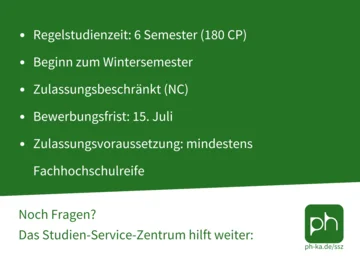
- Application deadline
- 15 July
- Authorisation
- Selection process
- Duration of study
- 6 semesters
- Scope
- 180 CP
- Conclusion
- Bachelor of Arts (BA) and State-recognised Early Childhood Educator
- Start of studies
- Winter term
The programme covers theoretical and empirical foundations against the background of current issues and questions in the field of early childhood education. It complies with the ‘Early Childhood Education’ core curriculum adopted on 15 September 2022 by the Early Childhood Education Programme Committee. This document describes the common core of Bachelor’s degree programmes in early childhood education and provides guidance on the structure of their key content.
The Childhood Education programme at our university also follows a transdisciplinary approach. This enables you to acquire a diverse range of skills within the context of current research. A particularly close integration with non-university learning environments also enables you to engage in practice-oriented learning.
The Institute for Early Childhood Education is responsible for the degree programme, its content and the modules.
Career prospects
This degree programme qualifies you to work in a variety of fields:
- Institutions providing education, care and upbringing for children aged 0 to 12: nursery schools, family or parent-and-child centres, primary schools or all-day schools, children’s and youth centres, educational support services, organisations representing children’s interests, etc.
- Institutions providing counselling, support and (further) training for parents with children aged between 0 and 12: family education centres, family offices, family counselling centres, educational support services, etc.
- Institutions providing advice, support and (further) training for educators working with children aged 0 to 12: specialist advisory services, providers of in-service and further training, etc.
- Institutions providing advice and support to public and independent bodies within the education and childcare system: education offices, planning committees at local, regional and national levels, etc.
This is based on the career profile of the ‘Early Childhood Education’ degree programme.
Entry requirements
This degree programme is subject to restricted admission. We conduct our own university-specific selection process for this. In addition to your final school-leaving grade, we also take into account your extracurricular achievements and experiences. The details are set out in the Admissions Regulations, which you can find under ‘Legal Basis’ for the degree programme.
There are 80 places available per year group.
Course structure
The standard duration of study is six semesters and includes three practical placements totalling at least 800 hours. In total, you will study 15 modules, the content of which is based on the core curriculum in early childhood education.
Elective modules allow you to specialise in specific areas: from the third semester onwards, you will study two specialisations within the five educational areas of Aesthetic Experience in Childhood, Physical Activity, Mathematics, Nature and Language.
| No. | Module title | CP |
|---|---|---|
| M1 | Studying Early Childhood Education – Foundations and Introductory Course | 10 |
| M2 | Child Development Psychology and Child Protection | 9 |
| M3 | Foundations specific to the professional field | 11 |
| M4 | Fundamentals of Domain-Specific Educational Processes I | 18 |
| M5 | Fundamentals of Domain-Specific Learning Processes II | 12 |
| M6 | Professional Perception and Action | 12 |
| M7 | Designing Domain-Specific Educational Processes I (Focus Area I) | 10 |
| M8 | Diversity and Anti-Discrimination | 8 |
| M9 | Semester placement | 30 |
| M10 | Cooperation and Participation | 12 |
| M11 | Designing Domain-Specific Educational Processes II (Focus Area II) | 10 |
| M12 | Inquiry-based learning – methodology and practical research | 8 |
| M13 | Control, Organisation and Management | 8 |
| M14 | Social Pedagogy – Social Work | 12 |
| M15 | Bachelor’s thesis | 10 |
Work placements
Throughout the six semesters of the programme, there is a close integration of theory, empirical study and practical experience. We ensure the interlinking of university-based learning and work-based learning through three integrated work placement phases. In total, you will complete 800 hours of compulsory work placements during your studies.
| Content and scope | Examination requirements | |
|---|---|---|
| 1. Practical phase | Orientation placement: minimum duration 200 hours, linked to M3 (February to March). You will explore one or two early childhood education settings, focusing on institutional and legal frameworks. | Portfolio |
| 2. Practical phase | Semester placement: Minimum duration 600 hours, linked to M9 (April to September). You will carry out supervised professional work in one or two early childhood education settings, with a focus on applying the skills acquired during your studies in professional practice. You will reflect on your actions in terms of their impact on the development of individuals, groups and social environments, as well as on your own professional identity. | Practical placement report |
| 3. Practical phase | Research project | Service learning with no defined minimum duration, linked to M12. You will gain practical experience in applying quantitative or qualitative methods of empirical social research. You will apply methodologies in the field of systematic, methodologically controlled case studies or carry out research assignments. This serves to apply and integrate your theoretical knowledge from the seminars in a practical and meaningful way. | Poster presentation |
If you have any questions, please contact the relevant person:
Organisation
Karlsruhe University of Education
Building
2
Room
B315
Phone
Availability
Office hours:
Monday, 02:30 pm – 04:00 pm (after registering on StudIP)
Crediting of work already completed
Once you have received your offer of admission from us, you will have the opportunity to have academic credits (for example, from another degree programme) or non-academic credits (for example, from a completed training or further education course) recognised. This is subject to the condition that there are equivalences with the programme’s curriculum. The guide to credit transfer provides you with a detailed overview of the options for credit transfer and the procedure to follow in advance.
If you have any questions, please contact the relevant person:
Organisation
Karlsruhe University of Education
Building
2
Room
B313
Phone
Availability
By arrangement


Programme Management and Coordination
Organisation
Karlsruhe University of Education
Building
2
Room
B310
Phone
Availability
By arrangement
Organisation
Karlsruhe University of Education
Building
2
Room
B315
Phone
Availability
Office hours:
Monday, 02:30 pm – 04:00 pm (after registering on StudIP)
Legal basis
Updated on 10 September 2026 by Kordula Manegold