


Teaching and Learning Lab PHyLa Physics
The PHyLa Teaching and Learning Laboratory serves, on the one hand, as an out-of-school learning centre on physics-related topics for school pupils in the greater Karlsruhe area. On the other hand, it enables our students to gain their first teaching experience in the teaching and learning of physics at an early stage.
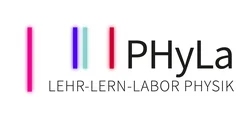
PHyLa is open to all types and levels of school. The programme focuses primarily on lower secondary and primary education. However, through our partnership with KIT, we also run projects for upper secondary education. We offer project days on various physics topics, which school classes can attend. These project days are developed and delivered by trainee teachers.
Statistics since 1 October 2022
-
4.874:
Pupils
-
214:
Classes
-
57:
Schools
News
Schedule for a project day
School class visits usually take place on Thursday and Friday mornings and are ideally integrated into the teaching programme to maximise their effectiveness.
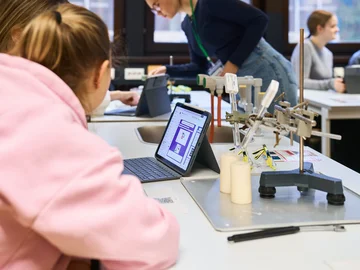
The project days are scheduled to last around three hours on average and include several breaks. The focus of the project days is on pupils conducting experiments independently. To this end, we make use of our extensive collection of materials. Visits to the Teaching and Learning Laboratory are free of charge, but you must register in advance.
Main focus: Physical aspects of climate change
There is no doubt that human activity is the main cause of global warming. Initiatives such as Fridays for Future demonstrate that the younger generation has recognised the vital importance of ensuring our planet remains habitable.
This is a complex challenge that can only be addressed through well-founded, scientific decisions. However, this requires a sufficient understanding of the physical causes and interrelationships so that pupils can follow the public debate and identify their own options for action. The Teaching and Learning Laboratory therefore focuses on the development and implementation of projects relating to the physical aspects of the anthropogenic climate crisis.
For primary school pupils
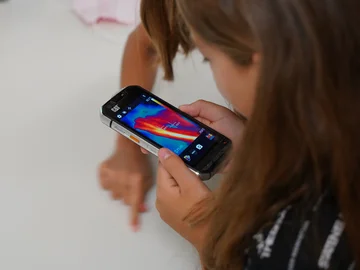
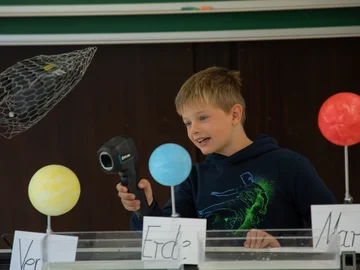
Climate data for Karlsruhe over the last 250 years shows that it is getting hotter and hotter in Karlsruhe. But why is this happening? Together with the pupils, experiments are carried out to investigate the factors that influence the Earth’s climate. Using models and experiments, the pupils work out answers to the question ‘Why is our Earth getting too warm?’.
Physical concepts (suitable for primary school pupils): heat, temperature, global warming, heat transfer via thermal radiation, the absorptive and reflective properties of surfaces
For primary school pupils
The project day centres on the topic of ‘renewable energy’. Among other things, pupils will explore what is meant by the term ‘renewable energy’, how a solar cell works, and how electricity can be generated using windmills and water wheels. Pupils learn about key aspects of renewable energy through various experiments. These practical examples make the topic of renewable energy tangible and easy to understand.
Physical concepts: energy as a physical concept, energy transfer
for pupils in ...
- ... Year 10 at secondary schools
- ... Years 10 and 11 at grammar schools / comprehensive schools
Here’s what your class can expect:
Together with the pupils, we will examine the Karlsruhe Climate Series. This consists of climate data from Karlsruhe covering the last 240 years, comprising over 250,000 data points. Using various analytical methods, we will investigate whether changes in Karlsruhe’s climate can be observed.
In addition, numerous experiments will be carried out to investigate factors influencing the Earth’s climate. Using models and experiments, the pupils will develop concepts relating to global warming, the effects of greenhouse gases and the emissivity of surfaces. The findings are used to explain observations drawn from the climate data. The project day lasts approximately 5 hours.
Physical concepts: heat, temperature, global warming, heat transfer via thermal radiation, the absorptive and reflective properties of surfaces, atmospheric physics
Opportunity to take part in a study on physics education
As part of an accompanying study on physics education, we will investigate during the project day how pupils use climate diagrams to support statements about climate change, and what role climate knowledge and views on climate change play in this process. We would be delighted if you and your class were to take part in the study. The study will take up around 40 minutes of the project day. Participation is voluntary and is not a prerequisite for attending the project day.
If you are interested in attending the ‘Karlsruhe and Climate Change’ project day with your class, please feel free to book a slot in our calendar.
Available project days on other topics in physics
For primary school pupils
Climate data for Karlsruhe over the last 250 years shows that it is getting hotter and hotter in Karlsruhe. But why is this happening? Together with the pupils, experiments are carried out to investigate the factors that influence the Earth’s climate. Using models and experiments, the pupils work out answers to the question ‘Why is our Earth getting too warm?’.
Physical concepts (suitable for primary school pupils): heat, temperature, global warming, heat transfer via thermal radiation, the absorptive and reflective properties of surfaces
For primary school pupils
Year after year, migratory birds change their habitat for several months. In doing so, they cover vast distances and never ‘lose their way’. During the project day on magnetism, pupils use this context to learn about the properties of magnets, how they work and the structure of the Earth’s magnetic field.
Physical concepts (suitable for primary school pupils): magnetic field, structure of a magnet, Earth’s magnetic field
For lower secondary school pupils
How does the human body stay warm in Arctic cold, and how does it cool down in the blazing desert sun? The ‘Body Temperature Regulation’ project day addresses these questions and explores how the body regulates its temperature. Through experiments, pupils will gain an understanding of how the body regulates its temperature.
Physical concepts: temperature, heat, heat transfer via radiation, conduction and convection, energy
For lower secondary school pupils
This project day focuses on light and colours. How can colours be mixed, how does light influence our perception, and how do we actually perceive colours with our eyes? Through a series of experiments, we will seek answers to these questions and explore the fascinating properties of light and colours.
Physical concepts: additive and subtractive colour mixing, the spectrum of light
For lower secondary school pupils
This project day focuses on the ‘eye’ – from a physics perspective. For example, we will explore how the eye is structured and how it enables us to see clearly in a wide variety of situations. Against this backdrop, pupils will be introduced to the physical principles of optics, such as the refraction of light and the properties of lenses.
Physical concepts: path of light through a lens, refraction, accommodation
For primary school pupils
Energy plays an important role in many everyday situations, whether it’s at breakfast, when driving, when climbing mountains, or when it comes to lighting and electricity. In primary school, the concept of energy should be introduced as early as in general studies, laying the foundations for an understanding of energy. During this project day, pupils will learn through a variety of hands-on experiments where energy plays a role in everyday life. The project day ties in directly with the required sub-competencies of the General Studies curriculum (4.2.3.4) and should ideally be undertaken before the project day ‘Sun, Water and Wind: Discovering Renewable Energies’.
Physical concepts: energy as a physical concept, energy transfer, energy storage
For primary school pupils
The project day centres on the topic of ‘renewable energy’. Among other things, pupils will explore what is meant by the term ‘renewable energy’, how a solar cell works, and how electricity can be generated using windmills and water wheels. Pupils learn about key aspects of renewable energy through various experiments. These practical examples make the topic of renewable energy tangible and easy to understand.
Physical concepts: energy as a physical concept, energy transfer
for pupils in the ...
- … Year 10 at secondary schools
- ... Year 10 and Year 11 at grammar schools / comprehensive schools
Here’s what your class can expect:
Together with the pupils, we will examine the Karlsruhe Climate Series. This consists of climate data from Karlsruhe covering the last 240 years, comprising over 250,000 data points. Using various analytical methods, we will investigate whether changes in Karlsruhe’s climate can be observed.
In addition, numerous experiments will be carried out to investigate factors influencing the Earth’s climate. Using models and experiments, the pupils will develop concepts relating to global warming, the effects of greenhouse gases and the emissivity of surfaces. The findings are used to explain observations drawn from the climate data. The project day lasts approximately 5 hours.
Physical concepts: heat, temperature, global warming, heat transfer via thermal radiation, the absorptive and reflective properties of surfaces, atmospheric physics
Opportunity to take part in a study on physics education
As part of an accompanying study on physics education, we will investigate during the project day how pupils use climate diagrams to support statements about climate change, and what role climate knowledge and views on climate change play in this process. We would be delighted if you and your class were to take part in the study. The study will take up around 40 minutes of the project day. Participation is voluntary and is not a prerequisite for attending the project day.
If you are interested in attending the ‘Karlsruhe and Climate Change’ project day with your class, please feel free to book a slot in our calendar.
Team and Contact
Organisation
Karlsruhe University of Education
Building
2
Room
A140
Phone
Availability
Consultations by appointment via email.
Organisation
Karlsruhe University of Education
Building
2
Room
A126
Phone
Availability
By arrangement
Organisation
Karlsruhe University of Education
Building
2
Room
A124
Phone
Availability
By arrangement
Organisation
Karlsruhe University of Education
Building
2
Room
A128
Phone
Availability
By arrangement: Tuesday, Thursday and Friday 8:30-15:00
PHyLa is funded by

Updated on 5 November 2026 by Central Web Editorial Office