


Teaching and Learning Lab for Technical Education
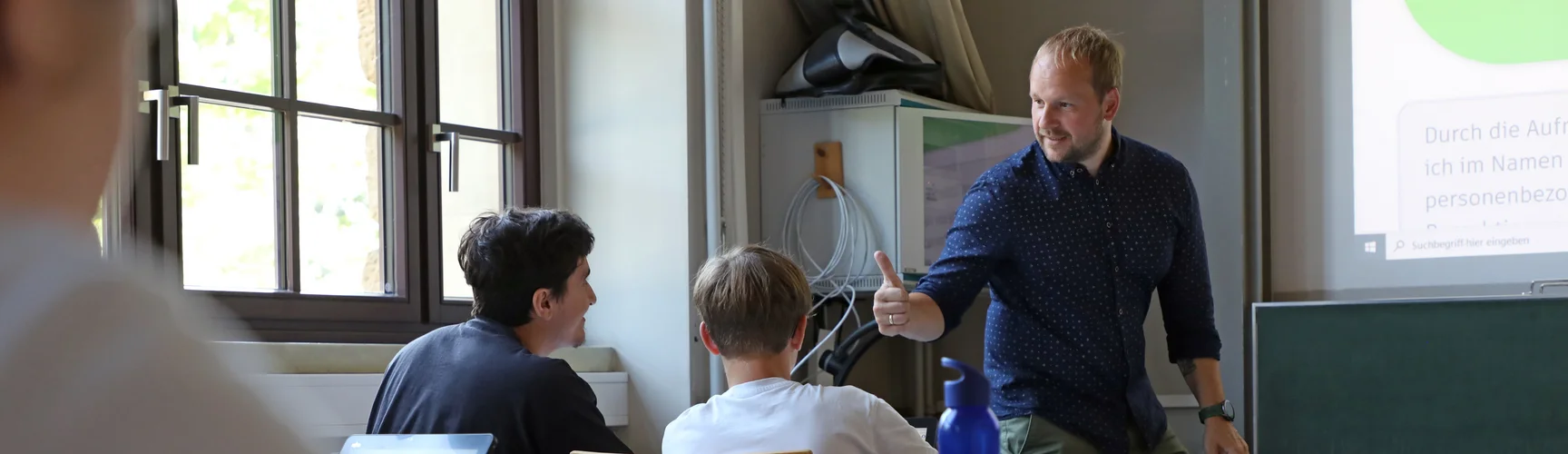
The Teaching and Learning Laboratory for Technology (LLL Technology) focuses on the practical experience and understanding of technical concepts. It combines technical education, creativity and problem-solving skills. Pupils, trainee teachers and teaching staff have the opportunity here not only to learn about technology in theory, but also to actively discover, develop and reflect on it.
The LLL Technology is part of our university’s STEM profile within a culture of sustainability.
What we offer
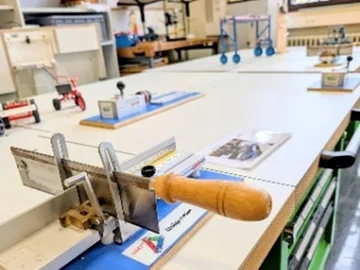
We provide a modern learning workshop equipped with tools, materials and digital technologies. We offer a space for creative solutions in areas such as robotics, design, 3D printing, programming, renewable energy and automation. You will have the opportunity to deliver and analyse practical technology lessons.
Rooms and learning areas
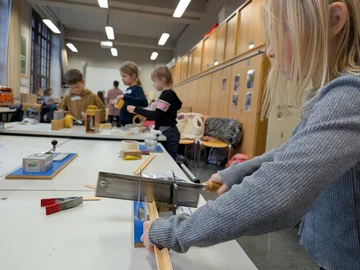
- In the workshop, apprentices acquire practical skills and explore the properties of materials. They work with wood, metal and plastics, as well as with hand tools and machinery.
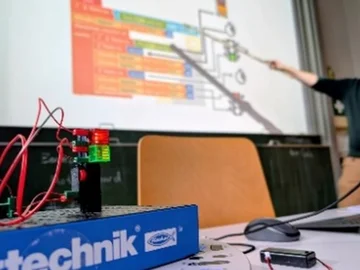
- In the electrical laboratory, apprentices develop electrical circuits, implement sensor-actuator systems and programme control and regulation processes. In this way, mechanical, electrical and IT components are integrated with one another.
- Pupils develop CAD models and produce them using additive manufacturing processes (such as 3D printing) as well as – depending on the purpose – subtractive or selective manufacturing processes (such as milling or laser cutting).
- In the ceramics studio, technical education is enriched with design and aesthetics, demonstrating that technical thinking is closely linked to creativity.
- In the classroom, which serves as a space for reflection, specific teaching units are developed alongside traditional teaching methods. It is the place where theory and practical experience are discussed and reflected upon from both a subject-specific and a pedagogical perspective.
Our objectives
- To inspire enthusiasm for technology and technical thinking, and to promote technical education through activity-based learning,
- to prepare trainee teachers for teaching technology in a practical manner, and
- strengthen collaboration between schools, higher education institutions, the skilled trades and industry.
Cyclical professionalisation
In the LLL Technology programme, we view the teaching process as a cycle of planning, implementation and reflection, in which students develop, deliver and reflect on courses. They then revise their teaching concepts and document them in such a way that subsequent students can build upon them when carrying out teaching and learning activities.
This cycle is supported by experienced technology educators, creating a form of collegial supervision in which feedback, professional self-reflection, and the interplay between theory and practice are interwoven. Three target groups benefit from this:
- Students deepen their subject-specific teaching competences and gain supervised teaching experience.
- Pupils are given additional learning opportunities in which they can engage with technical issues beyond the scope of regular lessons and reflect on and put into perspective any negative preconceptions they may have about technology.
- Teachers, in turn, gain inspiration for their lessons and can further develop their subject-specific and pedagogical repertoire through peer exchange.
Our offers
Courses are currently being developed and piloted. To date, the LLL Technology programme comprises the following learning opportunities.
For lower and upper secondary levels:
- Designing CAD models followed by fabrication (3D printing or laser cutting);
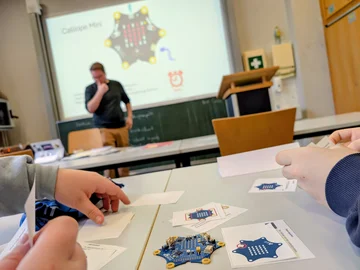
- Measurement, control and regulation using microcontrollers and generative AI chatbots.
For primary school (in preparation):
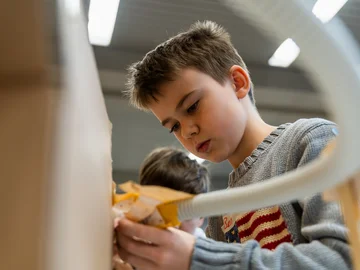
- Building a marble run in the children’s workshop using hand-held tools;
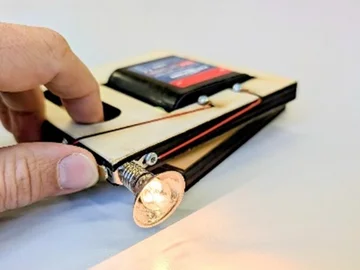
- Building a torch to learn about simple electrical circuits.
Research activities
The LLL Technik initiative aims to enhance learning effectiveness through systematic, iterative reflection and targeted preparation and follow-up of the programmes on offer. Empirical research is currently focusing primarily on learning processes, for example, whether reflective, goal-oriented or spontaneous approaches to exploring digital tools promote knowledge acquisition. From this, recommendations for the design of digital and hybrid learning environments and situations can be derived.
A particular added value of the LLL Technik programme lies in the fact that students and school pupils can engage authentically: students within a familiar setting, and school pupils outside the usual school context, thereby creating a learning atmosphere less characterised by pressure to perform and facilitating better knowledge acquisition. Furthermore, students acquire research methodology skills by being actively involved in analytical considerations, conceptualisation and evaluation.
Publications
- Gideon, I. & Link, N. (2026). The benefits and side effects of using ChatGPT in programming – a pilot study in the Technology Teaching and Learning Lab. Lessons Learned Journal. https://doi.org/10.25369/ll.v6i1.109
- Gideon, I., Lurk, J., Kirste, T. & Link, N. (2025). Implementation and initial trials of the Technology Teaching and Learning Lab at the Karlsruhe University of Education. Annual Conference of the DGTB. Chemnitz. Scientific poster.
- Gideon, I. & Link, N. (2025). From the reflection on individual approaches to the systematic modelling of strategies that promote learning: A study on 3D CAD modelling processes. 10th JOTED Symposium on Technology Education. Schwäbisch Gmünd. Keynote presentation.
- Gideon, I. & Link, N. (2025). Use of an AI chatbot in microcontroller programming – An exploratory study within the framework of the Technology Teaching and Learning Laboratory. Lessons Learned Conference 2025. Dresden. Technical presentation.
Contact
Have we sparked your interest? Would you like to visit the Technology Teaching and Learning Lab with your school class? Please feel free to contact us by email.
Organisation
Karlsruhe University of Education
Building
3
Room
112
Phone
Availability
By arrangement
Student assistants: Petra Dörr and Anna Holzki.
Updated on 5 November 2026 by Kordula Manegold