

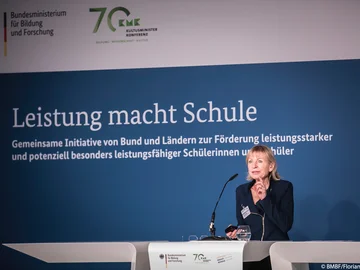
"Leistung macht Schule"
The “Leistung macht Schule” project stems from a joint initiative by the federal and state governments. It is scheduled to run for ten years (2018 to 2027) and aims to improve the development and achievement opportunities of all pupils, regardless of their background, gender or social status. Particular emphasis is placed on supporting pupils who are already performing exceptionally well, as well as those whose potential, abilities and skills have yet to be recognised and need to be developed through targeted support.
Researchers at the Karlsruhe University of Education are supporting the project as part of the interdisciplinary research network LemaS(-Transfer).
How is the “Leistung macht Schule” project structured? What does the research network do? What are the objectives of the federal-state initiative? The following video provides some initial answers.
Objectives
All pupils, with their diverse starting points in learning, should be supported in realising their individual potential, so that they can see themselves as self-reliant individuals, shape their own lives independently and take on responsibility within society. To this end, the project initiates and evaluates evidence-based concepts and processes at the core levels of school and teaching development.
The aim: greater educational equity through recognising and nurturing the potential and strengths of all pupils as a natural part of school and teaching. In line with this, the project aims to bring about a shift in attitude towards ‘achievement’ and ‘performance support’, based on a potential-oriented view of learners that recognises their potential and strengths as components of diversity.
First funding phase
During the first funding phase (2018 to June 2023), the interdisciplinary research consortium LemaS worked closely with 300 schools of all types on the further development of schools and teaching to promote talent and academic achievement. In consultation with school representatives, the researchers developed, tested and evaluated strategies, concepts and measures for the development of schools and teaching to foster talent and academic achievement across 22 sub-projects: the LemaS-P³ products.
Structure and content
During the first funding phase, the research consortium’s team comprised researchers from 18 universities. The structure of this first phase was modular and comprised 22 sub-projects aimed at the theory- and evidence-based optimisation of school development opportunities for high-achieving and potentially high-potential pupils. These 22 sub-projects were divided between the two compulsory core modules (CM) ‘Development of a school mission statement focused on performance-enhancing school development and the establishment of a cooperative network structure’ (CM 1) and ‘Challenging and supporting pupils in mainstream lessons’ (CM 2).
In addition, the federal-state initiative “Leistung macht Schule” provided supplementary funding for the two optional modules 3, “Diagnosis and counselling”, and 4, “Challenging and supporting pupils outside regular lessons”, which were the responsibility of the federal states.
Core Module 1 addressed and focused on school development aimed at fostering giftedness and academic achievement. The main priorities were the participatory development of a school mission statement geared towards a school culture that fosters giftedness and academic achievement, the establishment of both school-based and extracurricular network structures, and the design of transitions between school types that foster talent and academic achievement, with a focus on the STEM subjects.
Central to Core Module 2, ‘Challenging and Supporting Pupils in Mainstream Lessons’, was the theory-based development of practical, subject-specific and interdisciplinary concepts for individual, diagnosis-based support, as well as the development of complex task formats and differentiated teaching and learning opportunities. The further professional development of teachers with regard to teaching differentiated by potential and ability was also an integral part of this module.
Across all sub-projects, both core modules sought to establish a multidimensional, development-oriented concept of giftedness that encompasses pupils’ personal development and life context in addition to their academic achievements, and which forms the basis for the further development and transformation of schools and teaching.
Second funding phase
The LemaS-P³ products developed during the first phase are now to be further developed in individual schools during the second funding phase (July 2023 to 2027) – the transfer phase – and gradually embedded across the German school system. Teachers and school leaders from the LemaS schools involved in the first funding phase act as multipliers by sharing their experiences within school networks and providing advice on the use of the LemaS-P³ products.
The LemaS research consortium, now reorganised as the LemaS-Transfer research consortium, supports these multipliers in this task by providing professional development and support services. At the same time, the researchers are investigating the implementation and transfer processes. Key research findings are fed back into practice to further develop the professional development and support services.
The aim is to establish a school culture that fosters talent and academic achievement across the board, in which the potential of all pupils is nurtured, regardless of their background, gender or social status.
Support for the transfer of scientific knowledge
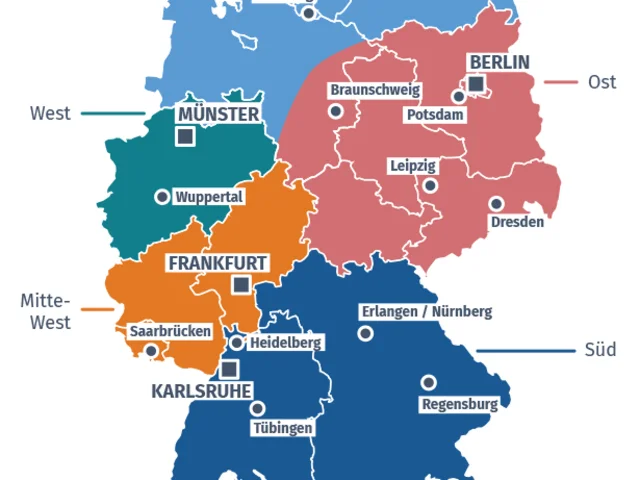
Scientific support for knowledge transfer takes place within region-specific school networks. Nationwide, these networks comprise schools in the first funding phase and newly joined schools in the second funding phase. Teachers and/or school leaders from the first phase act as multipliers in each network, forming a multiplier team together with representatives from a state institute or the state’s quality assurance body. These networks are organised across five regional centres (North, East, South, Central, West), into which the 16 federal states are divided into five regions. This enables the networks – which are in turn grouped into network consortia – to receive close guidance from the LemaS-Transfer research consortium and region-specific support.
The accompanying professional development programmes for teachers and school leaders take place both in person and online, and include training courses, reflection sessions, and consultation and discussion forums. The programmes and key areas are grouped into four content clusters:
- School development and collaborative networks.
- Cross-curricular teaching and school development.
- Subject-specific teaching development in STEM subjects.
- Subject-specific teaching development in languages.
Research into transfer, implementation and professionalisation
To address this research question, the research consortium is adopting a multi-perspective, interdisciplinary and multi-methodological research approach. This research approach encompasses both qualitative and quantitative strands. The research examines both transfer activities at all levels (multiplier teams, networks, network consortia, schools) and overarching transfer-related conditions for success. The research activities at the various levels are closely interlinked and fundamentally application-oriented, ensuring that the findings directly benefit both the further development of schools and the professional development of teachers.
In addition to researching the various areas of work, the provision of a digital infrastructure and community building are also among the research consortium’s key tasks. To this end, a digital distribution platform is being developed specifically to ensure the sustainable and target-group-appropriate use of LemaS-P³ products and professional development programmes.
LemaS in detail
LemaS at the Karlsruhe University of Education
Management
As the overall coordinator, Prof. Dr Gabriele Weigand heads the interdisciplinary research network LemaS and is responsible for key tasks relating to project coordination and management. At the Karlsruhe University of Education, she is supported by a team of research assistants. Her main responsibilities lie in the areas of coordination and (scientific) communication, human resources and committee work, methodological advice, research data management, transfer and professionalisation management, as well as representing LemaS-Transfer in political bodies.
Organisation
Karlsruhe University of Education
Building
2
Room
B202
Phone
Availability
By arrangement
Coordination team
Organisation
Karlsruhe University of Education
Building
2
Room
A025
Phone
Availability
By arrangement
Organisation
Karlsruhe University of Education
Building
3
Room
216
Phone
Availability
By arrangement
Organisation
Karlsruhe University of Education
Building
2
Room
B214
Phone
Availability
By arrangement
Organisation
Karlsruhe University of Education
Building
2
Room
B214
Phone
Availability
By arrangement
Organisation
Karlsruhe University of Education
Building
2
Room
B214
Phone
Availability
By arrangement
Southern Regional Centre
In addition to its overall coordination role, the Southern Regional Centre is also affiliated with the Department of General and Historical Educational Science at the Karlsruhe University of Education. It is headed by Jun.-Prof. Dr Sebastian Engelmann and Prof. Dr Gabriele Weigand. Their team consists of five research assistants who provide academic support to the school networks in Baden-Württemberg and Bavaria and support them through professional development programmes in the areas of school development that promotes talent and academic achievement, as well as through collaborative networks. Their remit also includes the systematic investigation of the conditions for success, adaptation processes and the effects of professional development programmes, as well as the quality assurance of these programmes.
Organisation
Karlsruhe University of Education
Building
2
Room
B226
Phone
Availability
By arrangement
Organisation
Karlsruhe University of Education
Building
2
Room
B202
Phone
Availability
By arrangement
Team
Organisation
Karlsruhe University of Education
Building
3
Room
216
Phone
Availability
By arrangement
Organisation
Karlsruhe University of Education
Building
3
Room
216
Availability
By arrangement
Organisation
Karlsruhe University of Education
Building
3
Room
216
Phone
Availability
By arrangement
Organisation
Karlsruhe University of Education
Building
3
Room
216
Phone
Availability
By arrangement
Organisation
Karlsruhe University of Education
Building
3
Room
216
Phone
Availability
By arrangement
Content cluster 4: Subject-specific curriculum development in the field of languages
Under the leadership of PD Dr Beate Laudenberg, the Department of German Language and Literature is home to a site of the LemaS Content Cluster 4, ‘Subject-Specific Teaching Development in the Field of Languages’. Together with her research assistant and the research teams at two other university sites (Goethe University Frankfurt and the University of Potsdam), she is developing a needs-based and subject-specific professional development programme on this priority area to provide further training for the multipliers involved in the transfer phase (2023–2027). The professional development framework encompasses all processes and measures relating to continuing professional development, such as explicit training programmes, reflection sessions, and consultation and discussion formats. This also includes systematic research into the conditions for success, adaptation processes and the impacts of the professional development formats, as well as quality assurance for these formats.
Organisation
Karlsruhe University of Education
Building
3
Room
207
Phone
Availability
By arrangement
Team
Organisation
Karlsruhe University of Education
Building
3
Room
205
Phone
Availability
By arrangement
Accompanying transfer and implementation research
The accompanying transfer and implementation research forms a further pillar of the academic support for knowledge transfer provided by the LemaS-Transfer research network. Two PhD positions and one postdoctoral post are based at the Department of General and Historical Educational Science within the Participatory Research priority area. Together with their colleagues at the other university sites (Goethe University Frankfurt, the University of Hamburg, the University of Münster and the Zurich University of Teacher Education), these early-career researchers use participatory research strategies to analyse the specific practices and processes of transfer within the complexities of everyday school life and to identify successful transfer and implementation processes in the school context.
Organisation
Karlsruhe University of Education
Building
2
Room
B226
Phone
Availability
By arrangement
Organisation
Karlsruhe University of Education
Building
2
Room
B202
Phone
Availability
By arrangement
Team
Organisation
Karlsruhe University of Education
Building
2
Room
A025
Phone
Availability
By arrangement
Organisation
Karlsruhe University of Education
Building
2
Room
B225
Phone
Availability
By arrangement
Impressions
Updated on 26 November 2026 by Central Web Editorial Office