


The sustainable integration of subject-specific digital teaching and learning approaches
This three-and-a-half-year BMBF project will enable the digital skills of teacher training students at the Karlsruhe University of Education to be further strengthened.
As part of the Quality Initiative for Teacher Training, funded by the federal and state governments, the Karlsruhe University of Education is further developing the Media Education and Digital Education module – which is already compulsory for its teacher training students – and is designing, testing and evaluating innovative digital teaching and learning concepts across seven subject-specific sub-projects, whilst further expanding its Innovation Space.
The project was led by Prof. Dr Klaus Peter Rippe, whilst project coordination and evaluation were in the hands of Prof. Mag. rer. nat. Dr. techn. Bernhard Standl.
News
Project description
In order to promote the digital skills of future teachers in a sustainable manner, the acquisition of these skills must be systematically integrated into the very first phase of teacher training. To this end, the InDiKo project at the Karlsruhe University of Education not only offers a media-related foundation module for all students but also addresses digitalisation-related skills in teaching at subject-specific level. This is supported by the interdisciplinary development of didactic design patterns and an exchange platform – the Innovation Space . The aim is to promote, develop and deepen students’ subject-specific digitalisation skills by integrating digital teaching and learning concepts into courses. The further-developed digital teaching and learning concepts are then translated into a more general form as didactic design patterns, enabling their seamless integration into various subjects. The Innovation Space is used both as a virtual learning environment and as a concept that facilitates real-world exchange between students, lecturers and researchers. The InDiKo project forms the basis not only for building up the cross-disciplinary and subject-specific digitalisation skills of teacher training students at the Karlsruhe University of Education, but also for promoting these skills continuously and sustainably.
Project structure
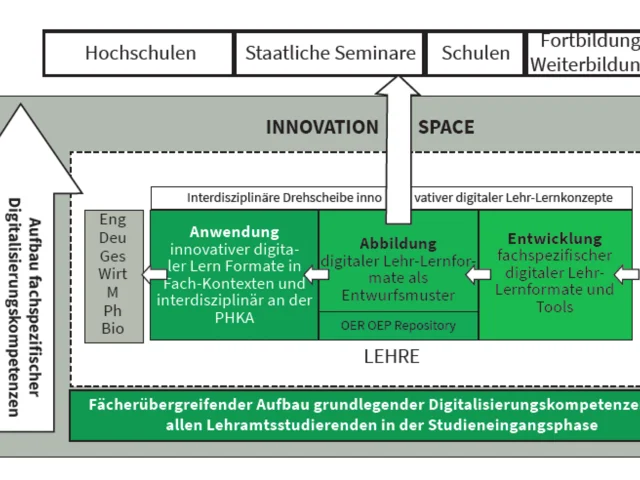
The following diagram shows the project structure of InDiKo. The teaching and learning concepts developed will be integrated into the participants’ courses with the aim of systematically building, promoting and deepening subject-specific digital literacy skills. In the first phase of the proposed project, the following subjects will contribute to this process: English, German, History, Economics, Mathematics, Informatics, Physics and Biology. In addition, the newly designed Innovation Space will be made available, featuring the integrated learning platform – a further development of the one already in place at the PHKA. Progress in the overall project and in the sub-projects will be systematically evaluated through accompanying empirical longitudinal studies.
-
44:
Project duration in months
-
7:
Sub-projects
-
2:
Millions of euros in funding
-
3:
Areas of development
Project organisation
Based on the current digitalisation strategy of the Karlsruhe University of Education, existing digitalisation measures are being systematically expanded and optimised across three areas of development. In InDiKo, amongst other things, the innovative digital concepts developed specifically for individual subjects are made available to all lecturers and students as didactically reusable design templates within the Innovation Space, which is due to be implemented. This approach enables the widespread dissemination of these digital concepts to other subjects within the Karlsruhe University of Education.
Area of development 1: Media literacy and digital literacy
Evaluation and further development of the core module designed to build fundamental digital literacy skills amongst trainee teachers in primary and lower secondary education.
Area of development 2: Sub-projects
Subject-specific development, testing and evaluation of innovative teaching and learning concepts using digital media within the sub-projects. The use of these teaching and learning concepts in subject-specific courses leads to the promotion, development and consolidation of subject-specific digital literacy skills. The subject-specific sub-projects utilise digital media for the development and design of innovative teaching and learning concepts.
In this sub-project, subject-specific digital teaching and learning concepts for foreign language teaching are being developed, tested and evaluated, which are particularly well-suited to virtual exchange.
In this sub-project, subject-specific digital teaching and learning concepts for foreign language teaching are being developed, tested and evaluated, which are particularly well-suited to virtual exchange.
This sub-project investigates how the development of web-based and VR quests for German lessons promotes digital literacy among (prospective) teachers.
This sub-project investigates how the development of web-based and VR quests for German lessons promotes digital literacy among (prospective) teachers.
This sub-project makes mobile learning accessible for extracurricular, historical, geographical and political learning in schools and higher education institutions. It enables teachers and learners to create their own extracurricular and virtual learning pathways and to share these with and for others. With the help of virtual reality (VR), remote learning locations can be brought into the classroom.
This sub-project makes mobile learning accessible for extracurricular, historical, geographical and political learning in schools and higher education institutions. It enables teachers and learners to create their own extracurricular and virtual learning pathways and to share these with and for others. With the help of virtual reality (VR), remote learning locations can be brought into the classroom.
The aim of this sub-project is to develop students’ digital literacy in the context of career guidance, covering various areas of digital application and practice at several levels.
The aim of this sub-project is to develop students’ digital literacy in the context of career guidance, covering various areas of digital application and practice at several levels.
In the subject of Mathematics, students are trained to evaluate existing digital teaching and learning concepts from the perspectives of media and mathematics pedagogy, to adapt them to their own needs, or to develop them further themselves.
In the subject of Mathematics, students are trained to evaluate existing digital teaching and learning concepts from the perspectives of media and mathematics pedagogy, to adapt them to their own needs, or to develop them further themselves.
In the subject of Physics, the focus will be on the digitalisation of physics experiments. Students will thus acquire subject-specific digital skills, such as in the area of digital data acquisition and analysis.
In the subject of Physics, the focus will be on the digitalisation of physics experiments. Students will thus acquire subject-specific digital skills, such as in the area of digital data acquisition and analysis.
This sub-project, which focuses on biology students, investigates the development of professional knowledge relating to the use of digital stereoscopic visualisations, in line with the TPACK model.
This sub-project, which focuses on biology students, investigates the development of professional knowledge relating to the use of digital stereoscopic visualisations, in line with the TPACK model.
Area of Development 3: Innovation Space
As a key principle for fostering close collaboration between the sub-projects in the second development area, successful digital teaching and learning concepts from the sub-projects are adapted into a new, standardised format, documented as didactic design templates, and made available in the Innovation Space.
Staff members
Management
Organisation
Karlsruhe University of Education
Building
1
Room
108
Phone
Availability
By arrangement
Area of development 1: Media literacy and digital literacy
Organisation
Karlsruhe University of Education
Building
3
Room
227
Phone
Area of development 2: Sub-projects
Sub-project 1: English
Organisation
Karlsruhe University of Education
Building
3
Room
222
Phone
Availability
Office hours (22 April to 29 July 2026):
Wednesdays 2:30 pm –3:30 pm in room 3.222
Tel: +49 721 925-4678
Personal Meeting Room (WebEx): https://ph-karlsruhe.webex.com/meet/isabel.martin
Sub-project 2: German
Organisation
Karlsruhe University of Education
Building
3
Room
206
Phone
Availability
Wednesdays, 9.45–10.45 am (room 3.206 or online) – Please register via my profile on Stud.IP.
By arrangement
Organisation
Karlsruhe University of Education
Building
3
Room
209
Phone
Availability
By arrangement
Sub-project 3: History
Organisation
Karlsruhe University of Education
Building
4
Room
412
Phone
Availability
I offer two weekly consultation hours during the semester. On Mondays, I am available in person (IV/seminar room) from 1.35 pm to 2.00 pm for signing documents and similar brief appointments (book via StudIP). On Thursdays from 10.50 am to 11.30 am, I offer an online consultation hour for longer appointments. You can contact me via the PH’s internal WebEX in my virtual consultation room. Please also book an appointment via StudIP (link: https://t1p.de/f35h)
-------------------------------------------------------------
If you are looking for supervision and topics for Bachelor’s and Master’s theses, you can find information here about possible topics that I would be happy to supervise. However, these are only suggestions, and you are welcome to adapt these topics or propose your own (link: https://trello.com/b/NNzYRpCd)
Organisation
Karlsruhe University of Education
Building
4
Room
405
Phone
Availability
By arrangement
Sub-project 4: Economy
Organisation
Karlsruhe University of Education
Building
4
Room
408
Phone
Availability
By arrangement
Organisation
Karlsruhe University of Education
Building
4
Room
409
Phone
Availability
By arrangement online or in person
Sub-project 5: Mathematics
Organisation
Karlsruhe University of Education
Building
2
Room
A244
Phone
Availability
By arrangement
Organisation
Karlsruhe University of Education
Building
2
Room
A242
Phone
Availability
By arrangement
Sub-project 6: Physics
Organisation
Karlsruhe University of Education
Building
2
Room
A140
Phone
Availability
Consultations by appointment via email.
Sub-project 7: Biology
Organisation
Karlsruhe University of Education
Building
2
Room
A302
Phone
Availability
By arrangement
Development Area 3: Innovation Space
Organisation
Karlsruhe University of Education
Building
2
Room
B141
Availability
By arrangement
Organisation chart
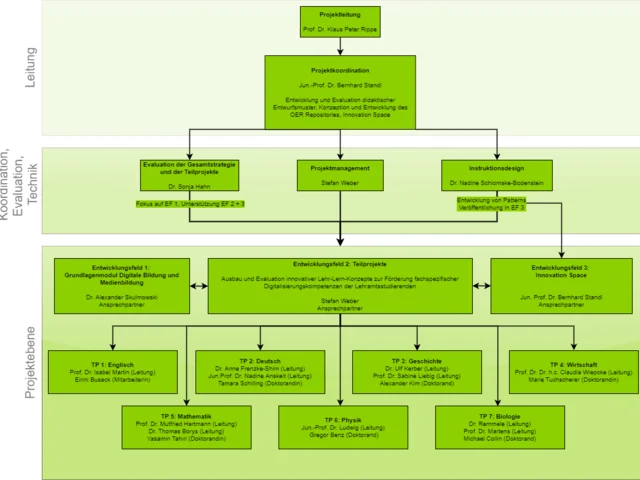
The following content is not accessible. If you would like accessible information about the structure of the project, please contact the Central Web Editorial Team.
Results reports

Publications
Publications
- Anskeit, N. (2021). “Technical jargon in the classroom?! A WebQuest on the use of foreign words in specialist texts.” In Deutsch 5–10, issue 67/2021, pp. 8–11.
- Benz, G. and T. Ludwig (2020a). “Developing the TPCK competences of future physics teachers in the field of digital data acquisition systems”. Science Teaching and Teacher Training in a State of Transition? Society for the Didactics of Chemistry and Physics, Annual Conference in Aachen 2020. Edited by S. Habig. University of Duisburg-Essen, pp. 414–417.
- Frenzke-Shim, A. (2022). “Teachers’ digital competences – professional development using the example of WebQuests”. In: WebQuests. A handbook for schools and higher education. Ed. T. Schilling. Schneider, pp. 54–67.
- Frenzke-Shim, A. (2022a). “WebQuests as a research-based learning environment in German lessons – potential and limitations.” In: WebQuests. A handbook for schools and higher education. Ed. T. Schilling. Schneider, pp. 109–124.
- Frenzke-Shim, A. and U. Kerber (2022). “Digital learning pathways, WebInstructs, WebQuests and Web Inquiry Projects – Approaches to the analytical categorisation of media-didactic design concepts.” In: WebQuests. A Handbook for Schools and Higher Education. Ed. T. Schilling. Schneider, pp. 21–37.
- Frenzke-Shim, A. and T. Schilling (2022). WebQuests. A Handbook for Schools and Higher Education. Ed. T. Schilling. Schneider.
- Frenzke-Shim, A. and T. Schilling (2022a). “Introduction”. In: WebQuests. A Handbook for Schools and Higher Education. Ed. T. Schilling. Schneider, pp. 3–19.
- Frenzke-Shim, A. and T. Schilling (2022b). “WebQuests in German Lessons – A Toolkit for Design”. In: Digital Learning in Primary Schools III. Edited by B. Brandt, L. Bröll and H. Dausend. Waxmann.
- Frenzke-Shim, A. and T. Schilling (2022d). “WebQuests: Supporting Internet-Based Research”. In: 01. German Digital Series. Edited by N. Anskeit.
- Frenzke-Shim, A. and T. Schilling (2021). And how on earth do I write this now?! – Targeted support for work processes in digital learning environments in the field of language, using WebQuests as an example. Workshop presentation at the 5th ZSL Digital Congress “Connected! Learning and Teaching in the Digital Age”.
- Hahn, S., A. Pfeifer and O. Kunina-Habenicht (2022). Multiple facets of self-rated digital competencies of pre-service teachers: A pilot study on the nomological network, empirical structure, and gender differences. In: Frontiers in Education 7. doi: https://doi.org/10.18716/ojs/midu/2022.2.10.
- Krath, J. et al., eds. (2022). Gamified Sustainable Entrepreneurship Education – A digital Educational Escape Room for economics classes in German secondary schools. Startplay 2022. Proceedings of the 1st Interdisciplinary Conference on Gamification Entrepreneurship. URL: https://kola.opus.hbz-nrw.de/frontdoor/index/index/docId/2379.
- Remmele, M., T. Müller and M. Collin (2022). “Teaching and learning biology in virtual worlds.” In: Dialog, the educational journal of the Karlsruhe University of Education.
- Schilling, T. (2022a). “Enabling a criteria-based analysis of WebQuests – development of a catalogue of criteria”. In: WebQuests. A Handbook for Schools and Higher Education. Ed. T. Schilling. Schneider, pp. 38–53.
- Schilling, T. (2022b). WebQuests as a digital learning environment for material-based writing. In: MiDU – Media in German Lessons 4.2, pp. 1–12. doi: https://doi.org/10.3389/feduc.2022.999679.
- Schilling, T. and A. Frenzke-Shim (2021a). “Designing resources for webquests”. Online workshop, Part 1: Self-study material on the topic of webquests (27 October 2021) and Part 2: Live workshop (24 November 2021), both as part of the “Deutsch Digital | Digital Continuing Professional Development” project.
- Schlomske-Bodenstein, N. and B. Standl (2022). “A Pilot Study to Identify Evidence-based Technology-enhanced Teaching Patterns in Pre-service Teacher Education.” In: Proceedings of the Society for Information Technology Teacher Education International Conference. Edited by E. Langran. Association for the Advancement of Computing in Education (AACE). doi: https://doi.org/10.3390/fi13050106.
- Standl, B. and N. Schlomske-Bodenstein (2021). “A Pattern Mining Method for Teaching Practices”. Future Internet 13.5. doi: https://doi.org/10.3390/fi13050106.
- Tahiri, Y. (2022a). “The effectiveness of using virtual reality and augmented reality in geometry lessons.” In: 20th Conference on Educational Technologies (DELFI). Edited by P. A. Henning, M. Striewe and M. Wölfel. Bonn: Gesellschaft für Informatik e.V, pp. 195–200. doi:https://doi.org/10.18420/delfi2022-033.
- Tahiri, Y., Florian, L. and Hartmann, M. (2022b). “Designing Intuitive Tools: Design Principles for the Development of Dynamic Geometry Software in Virtual Space”. In: MedienPädagogik: Journal of Theory and Practice in Media Education 47 (AR/VR – Part 1).
- Wiepcke, C. (2022). “Career Guidance in a Digital World (BOdigi)”. In: Dialog, the educational journal of the Karlsruhe University of Education.
Lectures
- Benz, G. (2021). “Scientific Reasoning with ‘Big Data’”. Presented at the GDCP Doctoral Colloquium 2021.
- Benz, G., D. Isele et al. (2022). “Experiments to promote skills in digital data acquisition.” Presented at the DPG Spring Conference 2022, online.
- Benz, G. and T. Ludwig (2022). ‘Small’ vs. ‘big’ data: the influence of reasoning on cognitive load and learning success. In: TP6, presented at the GDCP Annual Conference 2022, Aachen.
- Benz, G. and T. Ludwig (2022b). Competencies for the use of digital data-acquisition systems in physics lessons: description, assessment, development. In: TP6, presentation at the conference ‘Digitality in Teacher Education’ at the Karlsruhe University of Education.
- Benz, G., F. Kneller et al. (2021). “Competencies and self-efficacy in the use of digital data acquisition”. Presented at the Virtual GDCP Annual Conference 2021.
- Benz, G. and T. Ludwig (2021). “Big Data in Science Education – Chances, Challenges and Open Questions”. Presented at the ESERA Conference in Braga, Portugal.
- Borys, T. (2022). Cryptography in Advent. In: TP5, presentation at the conference ‘Digitality in Teacher Education’ at the Karlsruhe University of Education.
- Collin, M. (2022a). Methods for Bringing Stereoscopic 3D Visualisations into the Classroom. In: TP7, presentation at the conference ‘Digitality in Teacher Education’ at the Karlsruhe University of Education.
- Collin, M. (2022b). Teaching and Learning with Stereoscopic 3D Across Different Student Age Groups. In: TP7, presentation at the conference ‘Digitality in Teacher Education’ at the Karlsruhe University of Education.
- Frentz, J. and M. Tuchscherer (2022). Design and validation approaches for digital educational escape rooms in economic education. In: Presented as a lecture at the ‘Zukunftsforum Bildungsforschung’ (Future Forum for Educational Research) at the Heidelberg University of Education on 24 November 2022.
- Frenzke-Shim, A., N. Anskeit and C. Schreiber (2022). Perspectives on web quests. In: TP2, presentation at the conference ‘Digitality in Teacher Education’ at the Karlsruhe University of Education.
- Hahn, S. and O. Kunina-Habenicht (2021). “Symposium: Assessing media-related competences of trainee teachers: approaches and challenges.” Presented as part of a symposium at the 18th Conference of the Educational Psychology Section (PAEPSY 2021). Heidelberg (online).
- Hahn, S., A. Pfeifer and O. Kunina-Habenicht (2021a). “Factor structure of self-assessed, cross-curricular digitalisation-related competences among trainee teachers”. Presented as part of a symposium at the workshop: Teacher training following the pandemic-induced digital turn. Frankfurt, Germany. (25 June 2021).
- Hahn, S., A. Pfeifer and O. Kunina-Habenicht (2021b). “Conference paper: Self-reported media-related competences of teacher training students: factorial structures”. Presented as part of a symposium at the 18th Conference of the German Society for Educational Psychology (PAEPSY 2021). Heidelberg (online).
- Jürgen, F., M. Tuchscherer and C. Wiepcke (2022). Gamified Sustainable Entrepreneurship Education – A Digital Educational Escape Room for Economics Classes in German High Schools. In: TP4, presentation at the Startplay Conference, recipient of the Best Presentation Award, Karlsruhe University of Education, 5 August 2022.
- Kim, A. (2021). “The histoPAC Framework – Differentiation and Planning of Individual Learning Paths in Digital and Mobile History Teaching”. Presented at the “Zukunftsforum Bildungsforschung” conference at the University of Education, Freiburg, from 26 to 28 November 2021.
- Martin, I. and E. Busack (2022). Digital citizenship education and language teaching and learning: Creating learning paths for the development of media-didactic competences among pre-service teachers. In: Presented at “Digital Citizenship, Digital Wilds and Language Learning Teaching” in Salzburg, Austria.
- Remmele, M. (2021). “Presentation of the course on developing professional knowledge for the use of digital stereoscopic Cardboard technology in biology lessons”. Presented at the Joachim Herz Foundation’s fellow meeting on 27 November 2021 in Kassel.
- Remmele, M. (2022). “Digital visualisations in didactic settings – examples from the field of virtual reality.” Presented as a guest lecture (online) at the University of Duisburg-Essen (lecture series “Education in the Digital World”).
- Schilling, T. and A. Frenzke-Shim (2021c). “WebQuests in primary school German lessons”. Presented at the 3rd Symposium on Digital Learning, University of Chemnitz, 16–17 March 2021.
- Schlomske-Bodenstein, N. and B. Standl (2021c). “Identifying and Implementing Digital Teaching-Learning Scenarios in Pre-Service Teachers’ Perception of an Online Course in Mathematics.” Paper presented at the ECER Conference on Teacher Education Research, Geneva, Switzerland. (September 2021).
- Standl, B. and N. Schlomske-Bodenstein (2021b). “Conceptual modelling of TPACK for mapping teaching and learning scenarios”. Presented at the symposium workshop: Teacher education following the pandemic-induced digital turn. Frankfurt. (25 June 2021).
- Schlomske-Bodenstein, N., N. Hillah and B. Standl (2022). Pattern-Mining Workshop. In: EF3, presentation at the conference ‘Digitality in Teacher Education’ at the Karlsruhe University of Education.
- Standl, B., N. Hillah and N. Schlomske-Bodenstein (2022). Identifying Teaching Patterns in Pre-service Informatics Teacher Education. In: EF3, presentation at ISSEP, Vienna, 27 September 2022.
- Standl, B., N. Schlomske-Bodenstein et al. (2022). Interdisciplinary transfer between subject-specific didactics through the sustainable integration of subject-specific digital teaching and learning concepts. In: Paper presented at the conference of the Society for Subject Didactics in Vienna, Austria (August 2022).
- Standl, B. and O. Kunina-Habenicht (2020). “Sustainable integration of subject-specific digital teaching and learning concepts at the Karlsruhe University of Education (InDiKo)”. Presented at the digital exchange forum “Shaping Teacher Education Together” as part of the “Quality Initiative for Teacher Education” in Session 2: Media Literacy and the Use of Digital Media – How can teachers’ media-related competences be actively promoted? on 4 November 2020.
- Tahiri, Y. (2022a). Development of a VR application for geometry lessons. In: TP5, presentation at the Future Forum on Educational Research – Education in a World Shaped by Digitalisation at the Heidelberg University of Education, 25 November 2022.
- Tahiri, Y. (2022c). Geometry in virtual space. In: TP5, presentation at the conference ‘Digitality in Teacher Education’ at the Karlsruhe University of Education
- Tuchscherer, M. (2021a). “Digital Resources and Tools for Career Guidance: Findings from a Systematic Review”. Presented at the Baden-Württemberg Digital Congress, organised by the Centre for School Quality and Teacher Education (ZSL) on 2 October 2021.
- Tuchscherer, M. and C. Wiepcke (2021a). “Career Guidance in a Digital World”. Presented at the BOGYO (Career Guidance in Upper Secondary Schools) symposium at the joint event organised by ITB Bremen and IÖB Oldenburg on 20 July 2021.
- Tuchscherer, M. and C. Wiepcke (2021b). “Career Guidance in a Digital World – Draft of a Competence Model”. Presented at the annual conference of the DeGÖB (German Society for Economic Education), University of Siegen, 15–16 March 2021.
- Tuchscherer, M. and C. Wiepcke (2021c). “Digital Services and Tools for Career Guidance: Results of an Analysis”. Presented at the dvb (German Association for Educational and Career Guidance e. V.) symposium, a joint event organised by the German Association for Educational and Career Guidance e. V. (dvb), the Institute for Economic Education at the University of Oldenburg (IÖB) and the University of Applied Sciences of the Federal Employment Agency (HdBA)) on 10 September 2021.
- Tuchscherer, M. (2022a). “Digital Services and Tools for Career Guidance. Results of an Analysis.” Presentation and workshop (Concept for Career and Study Guidance at Grammar Schools (BOGY). Organised by the Centre for School Quality and Teacher Training) on 24 January 2022.
- Tuchscherer, M. (2022b). Digital services and tools for career guidance. Results of an analysis. In: Presentation and workshop (Concept for Career and Higher Education Guidance at Grammar Schools (BOGY). Organised by the Centre for School Quality and Teacher Education) on 24 January 2022.
- Tuchscherer, M. (2022c). Digital Career Guidance. Design and evaluation of a holistic concept for teacher training at universities. In: Presented as a poster and lecture as part of the Dies Academicus on 29 June 2022, Karlsruhe University of Education.
- Tuchscherer, M. (2022d). Opportunities and examples of digital career guidance in teacher education, Karlsruhe University of Education. In: Presented as a keynote lecture at the ZSL symposium in Freiburg on 18 November 2022.
- Tuchscherer, M. (2022e). Opportunities and examples of digital career guidance in teacher education, Karlsruhe University of Education. In: Presented as a talk at the ZSL symposium in Schwäbisch-Gmünd on 16 November 2022.
- Tuchscherer, M. (2022f). Opportunities and examples of digital career guidance in teacher education, Karlsruhe University of Education. In: Presented as a keynote address at the ZSL symposium in Karlsruhe on 7 December 2022.
- Tuchscherer, M., C. Wiepcke and L. Désirée (2022). Opportunities for digital career guidance in teacher education. In: TP4, presentation at the WINBO Conference, Karlsruhe University of Education, 12 July 2022.
- Wiepcke, C. and M. Tuchscherer (2022). Interview: Opportunities and limitations of digital career guidance tools, Karlsruhe University of Education. In: Interview conducted in Berlin at the BOP conference on 5 December 2022.
- Wiepcke, C., M. Tuchscherer and T. Brüggemann (2022). New Work, New Learning Trends in Digital Career Guidance; Digital Career Guidance in Teacher Education. In: TP4, presentation at the conference ‘Digitality in Teacher Education’ at the Karlsruhe University of Education.
- Wohlfart, O., S. Hahn and K. Bohrer (2022). Café of the Two Worlds – Research-Practice Transfer. In: Evaluation, presentation at the conference ‘Digitality in Teacher Education’ at the Karlsruhe University of Education.
Poster
- Benz, G., K. Arbogast and T. Ludwig (2021). “A framework for physics-specific technological competences in experimentation with digital data acquisition systems”. Poster presented at the virtual DPG Spring Conference 2021, 22–24 March 2021.
- Benz, G. and T. Ludwig (2020b). “Developing TPCK competences in future physics teachers in the field of digital data acquisition”. Poster presented at the GDCP Annual Conference 2020, 14–17 September 2020.
- Bühler, F. et al. (2022). MUSE4Anything: Ontology-based generation of tools for the structured collection of data. Poster presented at the DHd. (3 March 2022). In: EF3, poster presented at the DHd in Potsdam, (March 2022).
- Schilling, T. and A. Frenzke-Shim (2021b). “Quests instead of cramming: Fostering students’ digitalisation-related skills in German”. Poster presented at the QLB event ‘Teacher Training after the Pandemic-Driven Digital Turn’, Goethe University Frankfurt, 24–25 June 2021.
- Schlomske-Bodenstein, N. and B. Standl (2021a). “Graph-based reflection on one’s own teaching quality”. Poster presented at the AEPF in Mainz, Germany (September 2021).
- Schlomske-Bodenstein, N. and B. Standl (2021b). “Identifying and Implementing Digital Teaching-Learning Scenarios in Pre-Service Teacher Education”. EF3, poster presented at the EARLI Poster Session on Technology-Enhanced Learning and Instruction, Gothenburg, Sweden. (August 2021).
- Schlomske-Bodenstein, N. and B. Standl (2022a). Validation of a data structure for recording innovative teaching and learning scenarios using a Delphi study. In: EF3, poster presented at the GEBF, Bamberg, (March 2022).
- Tuchscherer, M. (2021b). “Digital Career Guidance: Design and Evaluation of a Holistic Concept for Teacher Training at Universities”. Presented as a digital presentation using a poster as part of the DeGÖB Young Researchers’ Forum (German Society for Economic Education) on 19 November 2021.
- Tuchscherer, M. (2022). “Digital Resources and Tools for Career Guidance: Findings from an Analysis.” Presentation and workshop (Design of Career and Study Guidance at Upper Secondary Schools (BOGY). Organised by the Centre for School Quality and Teacher Training) on 24 January 2022.
- Tuchscherer, M. (2022b). Digital Career Guidance. Design and evaluation of a holistic concept for teacher training at universities. In: Presented as a poster and lecture as part of the Dies Academicus on 29 June 2022, Karlsruhe University of Education.
Workshops
- Frenzke-Shim, A. and T. Schilling (2021). “So how do I write that now?! –
Targeted support for work processes in digital learning environments in the field of language, using WebQuests as an example. Workshop presentation at the ZSL Digital Congress “Connected! Learning and Teaching in the Digital Age”. - Schilling, T. and A. Frenzke-Shim (2021a). “Designing resources for WebQuests”. Online workshop, Part 1: Self-study material on WebQuests (27 October 2021) and Part 2: Live workshop (24 November 2021), both as part of the “Deutsch Digital | Digital Further Education” project.
- Tuchscherer, M. (2022). “Digital Resources and Tools for Career Guidance. Results of an Analysis.” Presentation and workshop (Concept for Career and Higher Education Guidance at Grammar Schools (BOGY). Organised by the Centre for School Quality and Teacher Training) on 24 January 2022.
Updated on 26 November 2026 by Central Web Editorial Office