

I would like to use critical teaching materials to demonstrate how colonialism shapes our present day.
With your consent, we store data on your device to analyze your usage behavior and seamlessly integrate external content for you. You can revoke your consent or make specific settings at any time.


I would like to use critical teaching materials to demonstrate how colonialism shapes our present day.
Colonial patterns of thought have become deeply entrenched in society, education and language worldwide. The research and practice project ‘Bi-directional Decoloniality’ addresses these structures. Drawing on postcolonial theories, curricula, teaching materials, processes, institutions, international collaborations and forms of knowledge production are critically examined and reciprocally decolonised through the collaboration of two teacher-training institutions from the Global South and North. The English language poses a particular challenge in this regard, as it is the medium in which colonial power relations were codified and which continues to exert an influence to this day (‘coloniality’). The participating scholarship holders and their fellow students at the Karlsruhe University of Education can carry this forward as future teachers in schools.
Since 2024, the project has been organised annually in cooperation with Engagement Global gGmbH under the ASA Academia Programme, funded by the BMZ, with university partners in Cameroon and Ghana, and is redesigned for each cycle. It offers six full scholarships and seminars for the participating students. Project #1104 (2026) ‘Helping to shape educational change: recognising and breaking colonial patterns, and rethinking curricula’ will run from 19 April 2026 to 31 December 2026 at the Karlsruhe University of Education (Phase 1) and the University of Cape Coast (Phase 2).
The aim of the project is the exploratory implementation of ‘decoloniality’ in research and teaching, in order to test possibilities for decolonial practice in contexts of the Global North and South. In the long term, this is intended to pave the way for (more) globally equitable perspectives, structures, and teaching content and methods in universities and schools. In doing so, the project pursues the following overarching UN Sustainable Development Goals (SDGs): #4 Quality Education, #10 Reduced Inequalities, #16 Peace, Justice and Strong Institutions, #17 Partnerships.
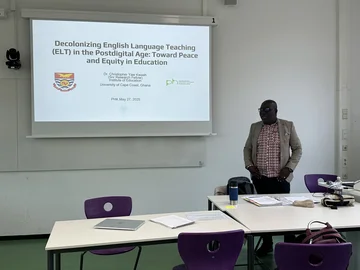
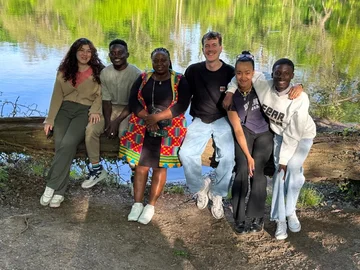
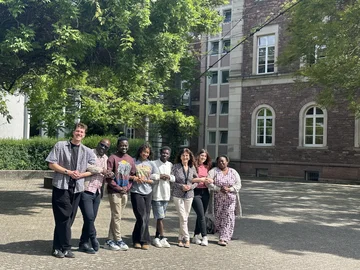
The project structure facilitates processes of bidirectional awareness of epistemic dominance and hierarchisation in the production of knowledge, as well as of one’s own patterns of thought. Project #1104 explores the colonial legacy embedded in the practices, methods, curricula and educational programmes of English language teaching in both Germany and Ghana, utilising a bidirectional approach to learning and teaching. This triggers processes of gradual (self-)decolonisation within a relatively short period of time.
In this way, the project engages in a (self-)critical examination of the collusions between Euro-Anglo-centric and Southern epistemologies through a bidirectional process of decoupling and ‘unlearning’. This catalyses a process of deconstructing colonial paradigms, initially within one’s own thinking. On this basis, English lessons can be scrutinised and reimagined, whilst the understanding of ‘knowledge’ can be broadened. Decolonial teaching units for English lessons are now being designed and trialled in schools. The pluricultural student body is responding to these initiatives with a high level of participation.
Work on the project’s objectives is carried out in three tandems, each consisting of one German student and one Ghanaian student. The project is open to students studying teacher training, pedagogy and educational science, as well as linguistics and literature, from across Germany. The students from Ghana are from the University of Cape Coast. The project consists of two phases, as well as supporting seminars offered by Engagement Global at various stages of the project. Both phases last three months each. In Phase 1, participants are based at the Karlsruhe University of Education. Phase 2 then takes place at the University of Cape Coast.
The project is funded by Engagement Global gGmbH as part of the ‘Work and Study Stays’ (ASA) programme. The main funding body is the Federal Ministry for Economic Cooperation and Development (BMZ). It is co-funded by internationalisation funds from the Rectorate of the Karlsruhe University of Education.
The project grew out of the insights, research findings and experiences gained from the project The Laos Experience (2015–).
The DAAD ‘Fact-Finding Mission’ in 2023 (I. Martin with R. Dengler & N. Hillah) during a research semester paved the way for the university cooperation agreements between the Karlsruhe University of Education and the two universities in Cameroon (University of Yaoundé 1) and Ghana (University of Cape Coast), and developed a systemic approach to fostering reciprocal decoloniality. Both partners took part in the 17th International Conference of the Association for Language Awareness (2024, PH Karlsruhe) and the ASA Academia projects in 2024 (‘Rethinking Education Systems: Decolonising Knowledge Production and Internationalisation’), 2025 (‘Questioning Our Own Knowledge: Decolonising Training for English Teachers’, #1107, p. 36) and 2026 (“Helping to Shape Educational Change: Recognising and Breaking Colonial Patterns, and Rethinking Curricula”) and now also in the DAAD “Get Ready for Global Teaching!” project (2025–2029) at the Karlsruhe University of Education.
Since 2024, contributions from ASA participants and tandems have been published on the project blog *The Laos Experience* (soon to be renamed *Bi-directional Decoloniality*). The three teams – XIII, XV and XVI – have written articles on their first impressions, progress in learning and unlearning, school projects and the results of their work. Each team writes an introductory and a concluding post. The blog began in 2015 by documenting the project ‘Bi-directional Teaching and Learning: Lao-German projects, tandems, and research’, and since 2017 the project work has been integrated into three new seminars.


Updated on 26 November 2026 by Isabel Martin