

Tackling the loss of biodiversity is one of the greatest challenges of our time. Our mission is to understand, communicate and conserve biodiversity.
With your consent, we store data on your device to analyze your usage behavior and seamlessly integrate external content for you. You can revoke your consent or make specific settings at any time.


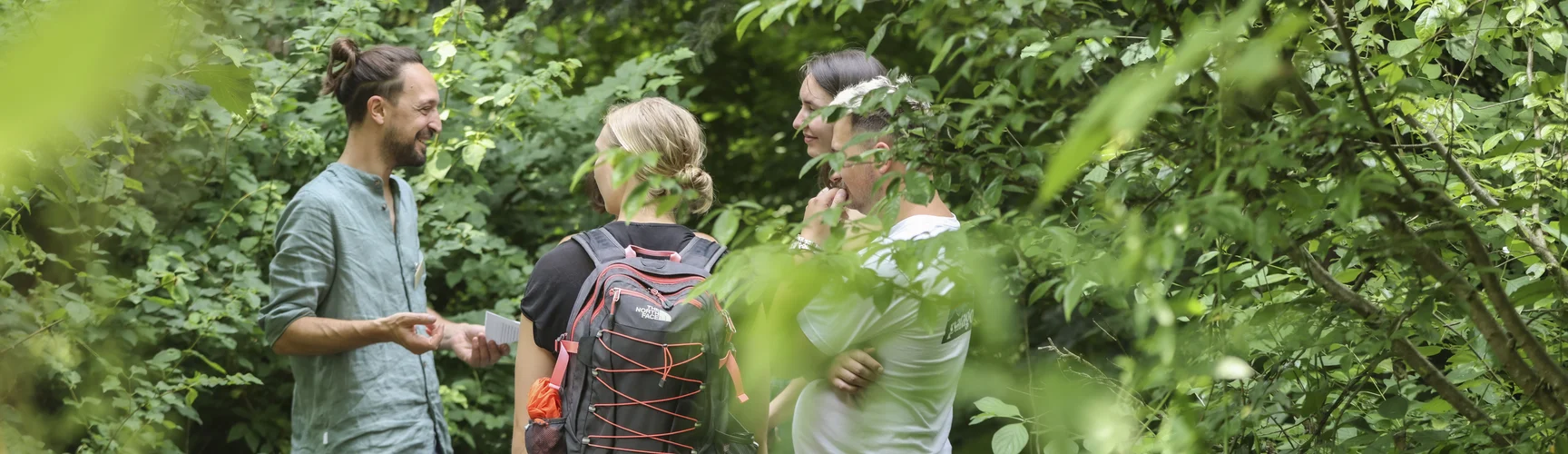
The protection and conservation of biological diversity are regarded worldwide as one of the most pressing challenges. However, sustainable species conservation cannot succeed without the expertise of specialists and public engagement. Environmental education plays a key role within the framework of lifelong learning and Education for Sustainable Development (ESD). This degree programme provides you with knowledge in the fields of biodiversity and environmental education, with a focus on ecology, organismic biology, and nature and species conservation.
Tackling the loss of biodiversity is one of the greatest challenges of our time. Our mission is to understand, communicate and conserve biodiversity.
A survey of alumni who studied the previous ‘Biodiversity and Environmental Education’ degree programme at our university over the last 10 years reveals the following picture regarding their career paths (a graduate tracking survey conducted in 2025 with a response rate of approximately 50 percent): Just under half of the students made a seamless transition from their studies to employment. A further 40 percent had found a job within six months at the latest. The range of roles is wide, spanning nature conservation and ecology (approx. 35 percent), education and teaching (approx. 30 percent), consultancy and planning (approx. 25 percent), and research and administration (approx. 10 percent). The following employers have taken on our graduates:
Admission to the programme requires prior study in the life sciences or educational sciences with a grade of 2.4 or higher. Your chances of securing a place on the course are improved by meeting specific selection criteria, for which relevant supporting documents (certificates, diplomas, etc.) are required:
You must provide evidence of your suitability and motivation by submitting a CV, an abstract of your final thesis and a personal statement.
International applicants whose first language is not German must demonstrate sufficient knowledge of German.
This Master’s programme has three main areas of focus:
Academic and professional competence, as well as reflective and communication skills, are overarching programme objectives. They provide the professional foundations required to take on advisory, advocacy and leadership roles.
The degree programme is a further development of the previous Master’s programme in Biodiversity and Environmental Education. When students on the previous programme are asked about their experiences during their studies, they highlight two key aspects that characterise our teaching practice: the close interaction and exchange of knowledge amongst themselves, and the individual support provided by the teaching staff. We are continuing this tried-and-tested teaching and learning approach in this programme as well.

The lecturers encourage us students to develop our individual strengths. This gives us the freedom to explore our personal interests in depth. The practical projects also offer considerable freedom in terms of subject choice, thereby enabling further specialisation.

My fellow students’ academic backgrounds are quite diverse; there are experts in various subjects, which I found to be a great asset. I particularly liked the fact that we had a great sense of camaraderie and were able to learn a lot from one another.
You will earn a total of 120 CP across ten modules. We offer modules 1 to 3 in the first semester and modules 5 to 7 in the second semester. Compulsory-elective module 4 spans both semesters. This gives you the opportunity to choose up to four compulsory-elective seminars from other Master’s programmes to complement the programme’s curriculum, for example from the ‘Migration, Education and Democracy’ programme and, from the 2026/27 winter semester onwards, also from the Digital Education programme: Psychology, Cognition, Design.
| Module title | Content | Grading |
|---|---|---|
| Module 1: Education in the Context of Global Developments | Education and Pedagogy in the Context of Global Developments | 5 CP |
| Module 2: Biology and Biodiversity | Introduction to Biodiversity Botanical Diversity Zoological Diversity | 10 CP |
| Module 3: Environmental Education and Sustainability | Earth’s Habitats Aquatic Ecology Ecological Perspectives on Sustainable Development | 9 CP |
| Module 4: Compulsory elective module: Professional development in sustainable education/development (2 sessions each in semesters 1 and 2) | Human Ecology Environmental Ethics Outdoor Education Project: Education for Sustainable Development (ESD) | 12 CP |
| Module 5: Research Methods/Statistics | Statistics Research Methods: GIS | 6 CP |
| Module 6: Nature Conservation and Biodiversity – Practical Aspects | Experiencing habitats first-hand Conservation Biology: Fieldwork Sessions Project: Bioindicators and Ecological Field Methods | 9 CP |
| Module 7: Nature Conservation and Environmental Education | Keystone species in ecology and nature conservation Acquiring species knowledge Methods of environmental education | 9 CP |
| Module 8: Research Module | Research-oriented project: accompanying course and project component | 15 CP |
| Module 9: Career-oriented work placement | Work placement Specialist specialisation | 12 + 3 CP |
| Module 10: Final dissertation | Colloquium Master’s thesis | 30 CP |
Organisation
Karlsruhe University of Education
Building
2
Room
B209
Phone
Availability
Please sign up here:
https://studip.ph-karlsruhe.de/studip/dispatch.php/consultation/admin?username=lieflaenderka
Organisation
Karlsruhe University of Education
Building
2
Room
B206
Phone
Availability
By arrangement
Organisation
Karlsruhe University of Education
Building
2
Room
B207
Phone
Availability
By arrangement
Organisation
Karlsruhe University of Education
Building
2
Room
A302
Phone
Availability
By arrangement
Organisation
Karlsruhe University of Education
Building
2
Room
A304
Phone
Availability
Office hours for the summer term 2026:
Tuesday 2:00 pm – 3:30 pm
Organisation
Karlsruhe University of Education
Building
2
Room
B209
Phone
Availability
Consultation hours: Please arrange by email or register via StudIP
Organisation
Karlsruhe University of Education
Building
2
Room
B226
Phone
Availability
By arrangement
Organisation
Karlsruhe University of Education
Building
2
Room
B302
Phone
Availability
Please register here:
https://t1p.de/parrisius-sprechstunde
If you have any questions about my courses, please contact:
fome-lehre@ph-karlsruhe.de
Organisation
Karlsruhe University of Education
Availability
By arrangement
Updated on 17 September 2026 by Kordula Manegold