


Subject: Physics
By studying physics at the Karlsruhe University of Education, students can gain the qualifications required to become a secondary school teacher specialising in physics at lower secondary level, for science and technology education with a focus on physics at primary level, as well as for vocational teaching.
What makes the subject of physics so special?
We aim to integrate the theoretical and practical components of the course at an early stage. To this end, we use the PHyLa teaching and learning laboratory. Here, our students work with ‘real’ school classes from an early stage; these classes visit our university for a morning. The teacher training students are supported by lecturers in the preparation, follow-up and delivery of these sessions. This gives the students their first practical experience, the school pupils benefit from a project day that is valuable in terms of physics teaching, and the accompanying teachers take away new ideas for their own lessons. The Teaching and Learning Laboratory is an integral part of the curriculum within the framework of seminars. However, Bachelor’s and Master’s theses are also completed within this framework.
We aim to integrate the theoretical and practical components of the course at an early stage. To this end, we use the PHyLa teaching and learning laboratory. Here, our students work with ‘real’ school classes from an early stage; these classes visit our university for a morning. The teacher training students are supported by lecturers in the preparation, follow-up and delivery of these sessions. This gives the students their first practical experience, the school pupils benefit from a project day that is valuable in terms of physics teaching, and the accompanying teachers take away new ideas for their own lessons. The Teaching and Learning Laboratory is an integral part of the curriculum within the framework of seminars. However, Bachelor’s and Master’s theses are also completed within this framework.
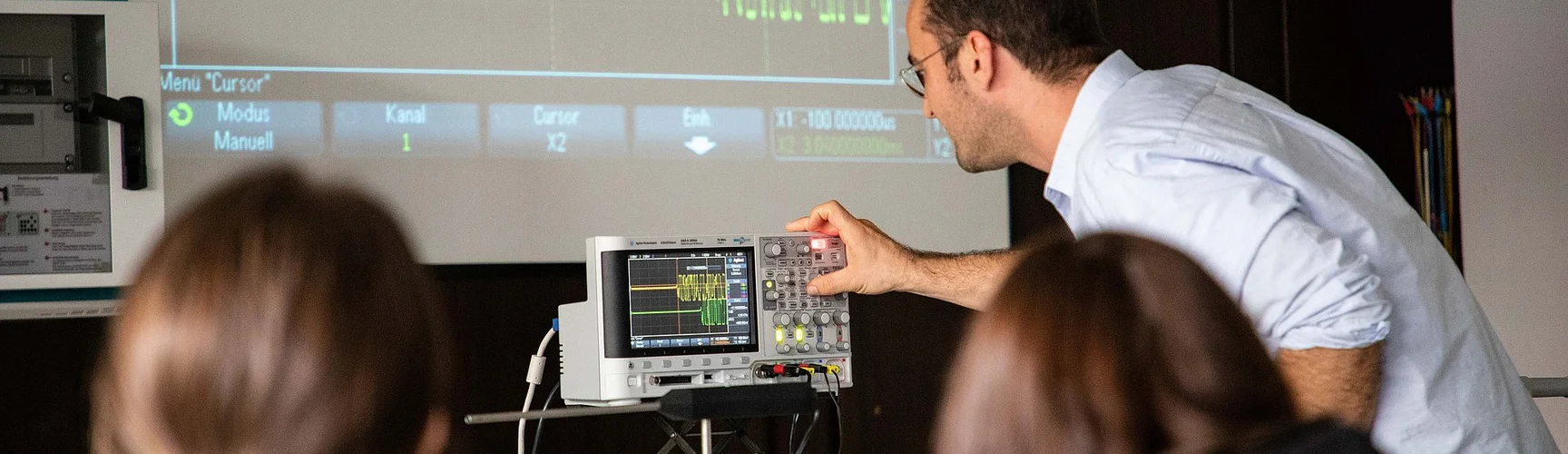
Experimentation is at the ‘heart’ of physics teaching. To ensure our students are well prepared for this, we have access to modern laboratories and an excellent physics collection, which has only just been modernised. Physics students also have access to a study room with its own library. It can be used for (collaborative) study, group work or simply to socialise with one another.
Experimentation is at the ‘heart’ of physics teaching. To ensure our students are well prepared for this, we have access to modern laboratories and an excellent physics collection, which has only just been modernised. Physics students also have access to a study room with its own library. It can be used for (collaborative) study, group work or simply to socialise with one another.
At numerous schools in and around Karlsruhe, pupils have the opportunity to join a Fischertechnik club. In the past, these clubs were often supported by physics students, who were able to gain additional experience in working with pupils as a result. Please do get in touch if you are interested. It could be your first close contact with a school.
At numerous schools in and around Karlsruhe, pupils have the opportunity to join a Fischertechnik club. In the past, these clubs were often supported by physics students, who were able to gain additional experience in working with pupils as a result. Please do get in touch if you are interested. It could be your first close contact with a school.
We collaborate with the Karlsruhe Institute of Technology (KIT) on a number of courses. At present, students from our university attend parts of the Experimental Physics A and B courses taught by Professor Schimmel at KIT and, to complement these, a corresponding practical session at our university.
In addition, large-scale experiments are carried out at KIT as part of Experimental Physics 1 and 2, to provide students with a broader range of experimental experience.
We collaborate with the Karlsruhe Institute of Technology (KIT) on a number of courses. At present, students from our university attend parts of the Experimental Physics A and B courses taught by Professor Schimmel at KIT and, to complement these, a corresponding practical session at our university.
In addition, large-scale experiments are carried out at KIT as part of Experimental Physics 1 and 2, to provide students with a broader range of experimental experience.
The number of participants in physics seminars is usually between 8 and 15 students. In lectures, this small number provides an opportunity to engage in discussion with the lecturer and fellow students. Questions can be addressed and solutions sought as a group.
In the seminars, the small number of participants gives students the opportunity to carry out experiments in small groups, put their own ideas into practice and develop unique projects.
The number of participants in physics seminars is usually between 8 and 15 students. In lectures, this small number provides an opportunity to engage in discussion with the lecturer and fellow students. Questions can be addressed and solutions sought as a group.
In the seminars, the small number of participants gives students the opportunity to carry out experiments in small groups, put their own ideas into practice and develop unique projects.
Formally, the modules in the teacher training programme, as listed above, are divided into subject-specific knowledge and subject-specific pedagogy.
The Department of Physics thrives on the fact that most courses integrate didactics, science and methodology. This provides students with a range of practical tools directly linked to the content they have learnt, enabling them to apply this knowledge in a school setting.
Formally, the modules in the teacher training programme, as listed above, are divided into subject-specific knowledge and subject-specific pedagogy.
The Department of Physics thrives on the fact that most courses integrate didactics, science and methodology. This provides students with a range of practical tools directly linked to the content they have learnt, enabling them to apply this knowledge in a school setting.
As students, for example, also deliver their own supervised lessons as part of work placements, the physics department’s extensive collection offers them plenty of opportunities to plan their lessons in a creative and modern way. The necessary materials can be borrowed for this purpose upon signing for them. It is recommended that students discuss their planned project with the department in advance.
As students, for example, also deliver their own supervised lessons as part of work placements, the physics department’s extensive collection offers them plenty of opportunities to plan their lessons in a creative and modern way. The necessary materials can be borrowed for this purpose upon signing for them. It is recommended that students discuss their planned project with the department in advance.
At the end of the Bachelor’s degree programme and at the end of the Master’s degree programme, students must write an academic thesis (Bachelor’s or Master’s thesis). In Physics, these theses are generally integrated into academic research projects. More detailed arrangements regarding the scope and research focus must be discussed with the supervising lecturer.
In Physics, academic theses are offered on the following broad topics, amongst others:
- Empirical research in physics education
- Experimental work
- ‘fischertechnik’ and personalised physics teaching
At the end of the Bachelor’s degree programme and at the end of the Master’s degree programme, students must write an academic thesis (Bachelor’s or Master’s thesis). In Physics, these theses are generally integrated into academic research projects. More detailed arrangements regarding the scope and research focus must be discussed with the supervising lecturer.
In Physics, academic theses are offered on the following broad topics, amongst others:
- Empirical research in physics education
- Experimental work
- ‘fischertechnik’ and personalised physics teaching
Possible degree programmes
The programme is structured around teaching, which the lecturers organise in a varied and interactive manner. In our teaching, we place particular emphasis on working in small groups, aspects of digital education and collaboration with KIT. Below is an overview of subject-specific and pedagogical courses, although subject-specific knowledge and pedagogy are closely intertwined in the physics programme at the Karlsruhe University of Education.
In addition, excursions are organised as part of various modules.
BA/MA in Physics (Lower Secondary Level)
| Subject-specific courses | Courses on subject-specific teaching methods |
|
|
BA/MA General Studies with a specialisation in Physics
| Below is a selection of the modules you will study under the 2022 Study Regulations if you choose Physics as your specialisation. The interdisciplinary parts of the modules are not listed here (e.g. 2 A–E, Module 4). | |
| Subject-specific modules | Subject-specific teaching methodology modules |
|
|
Insights
Head of Department
Are you thinking about studying physics at our university and would like some answers to your questions? Would you like advice on your degree programme or to have your prior learning assessed? Please get in touch with us:
Departmental Representative Committee
also known as FaVe or the student representative body
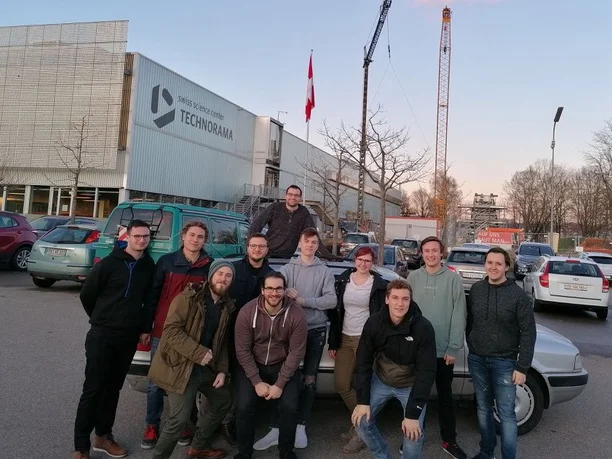
If you have any problems, questions, suggestions or ideas for excursions or similar matters, the Physics Students’ Association will be happy to help.
Simply get in touch with: Lisa König lisa.koenig@stud.ph-karlsruhe.de
Updated on 10 September 2026 by Central Web Editorial Office