
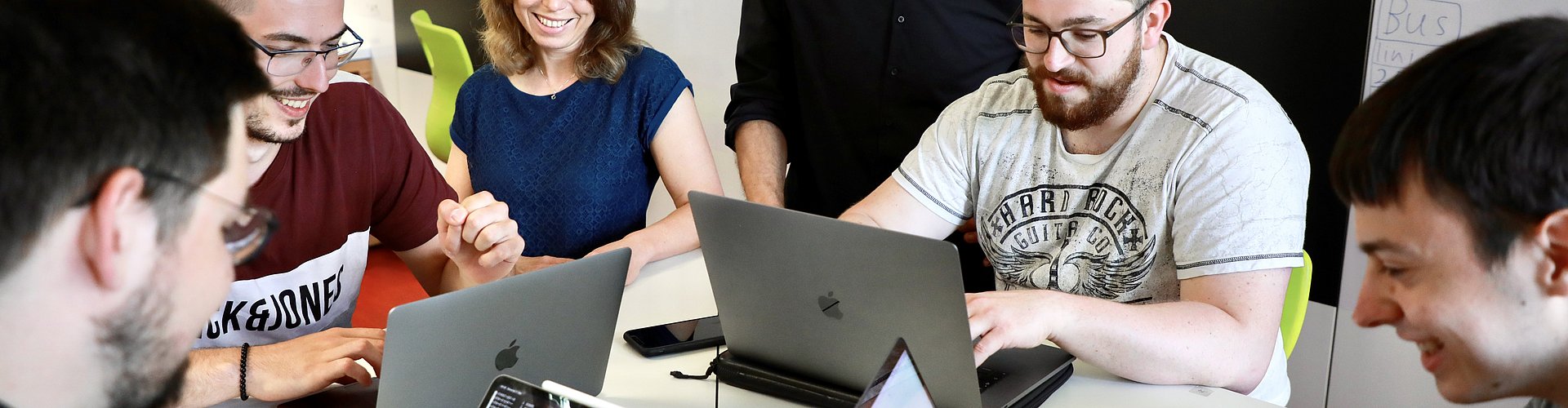
Informatik und ihre Didaktik
Die Forschungsschwerpunkte der Professur für Informatik und ihre Didaktik liegen in der empirisch fundierten Weiterentwicklung der Informatikdidaktik unter Bedingungen fortschreitender Digitalisierung und Künstlicher Intelligenz. Im Zentrum stehen wirksame Lehr-Lern-Designs, Kompetenzentwicklung sowie Fragen reflektierter digitaler Allgemeinbildung. Informatik wird dabei als Grundlage zeitgemäßer digitaler Bildung verstanden, die fachliches Verstehen, gesellschaftliche Reflexion und Handlungskompetenz verbindet.
Das Lehr-Lern-Labor Informatik ist das fachdidaktische Praxiszentrum der Professur für Studium und Schule. Es dient als Lern- und Erprobungsraum für Lehramtsstudierende der Informatik und für Schulklassen und verbindet universitäre Lehre, Forschung und schulische Praxis. Ziel ist die systematische Integration von Praxiserfahrungen in das Studium sowie die Förderung informatischer Kompetenzen von Schüler:innen.
Aktuelle Publikationen
Journals
Oser, A., & Standl, B. (2025). Teaching and Assessing Abstraction in K‐12 Computational Thinking Education: A Systematic Literature Review. Computer Applications in Engineering Education, 33(5). https://doi.org/10.1002/cae.70073
Bentz, A., Krasowski, J., Standl, B., & Wiepcke, C. (2024). Empowering K–12 pupils: Fostering problem-solving skills through sustainable entrepreneurship and computational thinking. Journal of the International Council for Small Business, 1–12. https://doi.org/10.1080/26437015.2024.2403030
Bentz, A., & Standl, B. (2024). Exploring interest in informatics with a focus on K-12 students’ preferences in the context of a robotics workshop. ACM Transactions on Computing Education.https://doi.org/10.1145/3698239
Konferenzen
Ritter, F., & Standl, B. (2025). Enhancing Algorithmic Thinking Through Semantic Waves: Integrating Necessity Learning Design in Computer Science Education. In 2025 IEEE Global Engineering Education Conference (EDUCON) (pp. 1-10). IEEE. https://doi.org/10.1109/EDUCON62633.2025.11016370
Kastner-Hauler, O., Standl, B., Sabitzer, B., & Lavicza, Z. (2024). Developing Design Principles for Computational Thinking Learning Environments: Pathways into Practice with Physical Computing. In 16th International Conference on Computer Supported Education (pp. 445–453). https://doi.org/10.5220/0012689600003693
Ritter, F., & Standl, B. (2024). Semantic waves: A strategy for algorithmic skills in K-12 computer science education. In 2024 IEEE Global Engineering Education Conference (EDUCON) (pp. 1–10). Kos Island, Greece. IEEE. https://doi.org/10.1109/EDUCON60312.2024.10578899
Frenzke–Shim, A., Kohl–Dietrich, D., Standl, B., Langner, M., Maedche, A., & Kerber, U. (2024). The evolving role of generative AI in text literacies: Exploring the potential of cognition-adaptive assistance. In 2024 IEEE Global Engineering Education Conference (EDUCON) (pp. 01–03). Kos Island, Greece. IEEE. https://doi.org/10.1109/EDUCON60312.2024.10578629
Standl, B. (2024). Strategies and Insights from Implementing a Teaching Learning Lab to Foster Computational Thinking Skills. In J. Cohen & G. Solano (Eds.), Proceedings of Society for Information Technology & Teacher Education International Conference (pp. 389-392). Las Vegas, Nevada, USA: Association for the Advancement of Computing in Education (AACE). https://www.learntechlib.org/primary/p/223961/.

Fakultät für Natur- und Sozialwissenschaften - Studiendekan
Raum 2.B141
Terminvereinbarung erforderlich: https://calendly.com/bernhard-standl/meeting
Das Team der Informatikdidaktik
 Felix Elias Agot
 Vincenzo Fragapane
Sprechzeiten nur nach Voranmeldung via Email.
 Dr. Nadine Schlomske-Bodenstein